Every industrial packaging engineer, supply chain director, and electronics procurement executive knows the devastating financial toll of transit damage. You design an exceptional consumer hardware product, automotive sub-assembly, or precision medical instrument, only to watch thirty percent of the shipment arrive at international distribution centers with shattered housings, scratched powder coats, or internal solder joint fractures. In ninety percent of logistics claims, the culprit is not rough handling by couriers; it is low-grade protective foam. Sourcing from unverified brokers results in under-foamed closed cells that collapse under static load, unstable blooming agents that emit noxious volatile organic compounds (VOCs), and weak thermal lamination that splits along the seam during cold-weather shipping. China is the undisputed manufacturing engine of expanded polyethylene (EPE) protective packaging, commanding over sixty-five percent of the global supply. However, navigating the landscape of epe foam packaging manufacturers in China requires looking past commercial directories to analyze resin purity, physical foaming extrusion ratios, cleanroom die-cutting tolerances, and automated lamination infrastructure. At Mailong Packaging, we extrude continuous EPE profiles, fabricate multi-density protective cushioning, and formulate custom anti-static compounds daily. Here is our direct practitioner evaluation of the 10 best epe foam packaging manufacturers in China, breaking down their engineering pedigree, production capabilities, and commercial reliability to protect your supply chain from catastrophic transit failures.
Quick Answer: Who Are the Leading EPE Foam Packaging Manufacturers in China?
The top 10 epe foam packaging manufacturers in China shaping global protective packaging are: (1) Mailong Packaging (Dongguan, Guangdong; the premier benchmark for vertically integrated EPE foam planks, precision CNC die-cut inserts, and specialized EVA hybrid cushioning); (2) Shenzhen Jingke Packing Material (Shenzhen, Guangdong; market leaders in anti-static ESD foam for consumer electronics); (3) Dongguan Sanshi Plastic Products (Dongguan, Guangdong; specialized in precision fabrication and furniture edge protection); (4) Kunshan Meiyaxing Packaging Materials (Kunshan, Jiangsu; the dominant Yangtze River Delta supplier for automotive components); (5) Wuxi Baoli Plastic Products (Wuxi, Jiangsu; technical innovators in continuous thermal lamination and heavy industrial blocking); (6) Huizhou Huitong Packaging (Huizhou, Guangdong; high-tonnage extrusion of standard EPE rolls and fruit protection netting); (7) Zhejiang Tianhe Foam Materials (Zhejiang; leaders in non-crosslinked closed-cell sheet export programs); (8) Foshan Shunde Shundian Packaging (Foshan, Guangdong; high-volume custom molded corner protectors for major appliance OEMs); (9) Ningbo Haishu Foam Packing Factory (Ningbo, Zhejiang; port-adjacent export specialist in sea-freight void fill and cushioning rolls); and (10) Qingdao Ruixing Packaging (Qingdao, Shandong; Northern export hub specializing in cold-chain thermal liners and heavy export cargo protection). For brands requiring rapid prototyping, custom Shore hardness tuning, and low container shipping cube loss, Mailong Packaging delivers the highest commercial return on investment.
Article Directory
- What It Is: The Solid-State Polymer Science of Expanded Polyethylene
- Quick Summary Table: Top 10 Chinese EPE Foam Manufacturers
- The 10 Best EPE Foam Packaging Manufacturers in China Evaluated
- Featured Engineering Spotlight: Mailong Packaging Precision EVA & EPE Solutions
- Direct Technical Comparison: Manufacturing Architecture and Quality Controls
- Pros and Cons: Direct Chinese Factory Procurement vs. Domestic Western Converters
- Commercial Benefits and Inherent Material Limitations of EPE Foam
- Who Needs High-Grade EPE Foam vs. Who Can Settle for Basic Bubble Wrap
- 5 Costly Mistakes Procurement Teams Make When Sourcing EPE Foam from China
- Essential Sourcing Checklist: Auditing a Chinese EPE Foam Factory
- Expert Procurement Verdict: The Strategic Supply Chain Blueprint
- Frequently Asked Questions
- Authoritative References & Packaging Standards
What It Is: The Solid-State Polymer Science of Expanded Polyethylene
To evaluate epe foam packaging manufacturers in China with technical authority, you must understand the thermodynamic and chemical mechanics of expanded polyethylene. EPE (also known as pearl cotton or non-crosslinked closed-cell polyethylene foam) is synthesized by melting low-density polyethylene (LDPE) resins under high pressure and temperature inside a tandem extrusion line, introducing an environmentally safe physical blowing agent (typically liquefied butane gas), and nucleating agents like talcum powder.
As the molten polymer exits the circular die head, the sudden pressure drop causes the dissolved butane to instantly vaporize, expanding the LDPE into millions of microscopic, independent closed cells. Unlike open-cell polyurethane (PU) foam, which acts like a sponge and absorbs moisture, EPE is an impenetrable barrier to water, dust, and oils. The closed-cell structure provides exceptional mechanical resilience:
- Elastic Memory and Multi-Drop Cushioning: Under dynamic compressive shock, the trapped air within each closed cell compresses elastically, decelerating the falling product. Once the shock wave dissipates, the polymer wall springs back to its original dimension without brittle cell-wall rupture. This allows EPE to survive repeated 10-drop transit test sequences under ISTA (International Safe Transit Association) Testing Standards, whereas expanded polystyrene (EPS / Styrofoam) shatters on the very first impact.
- Non-Abrasive Surface Tactility: EPE foam possesses an ultra-smooth, non-abrasive surface energy. When used for surface wrapping on high-gloss piano lacquers, polished stainless steel, or touchscreens, it prevents the micro-scratching (scuffing) that traditional cardboard or coarse bubble packaging induces during highway transit vibration.
- Chemical Inertness & Pure Recyclability: Because standard EPE is physically foamed without chemical crosslinking agents (unlike XLPE), it is a thermoplastic that can be melted down, re-granulated, and fed back into extrusion cycles, satisfying strict international circular economy legislation.
In most professional situations, EPE is deployed across thicknesses ranging from 0.5mm ultra-thin wrapping sheets up to 100mm+ multi-layer laminated structural planks. To evaluate specialized industrial formats, explore our comprehensive guide on EPE Foam Applications or discover roll formats across our dedicated EPE Foam Sheets catalog.
Quick Summary Table: Top 10 Chinese EPE Foam Manufacturers
| Manufacturer Name | Main Factory Hub | Primary Product Focus | Density Processing Range | Key Core Competency | Export Readiness |
|---|---|---|---|---|---|
| 1. Mailong Packaging | Dongguan, Guangdong | Custom CNC inserts, EPE/EVA hybrids, planks | 18 to 65 kg/m3 (Up to 90 Shore EVA) | High-precision die-cutting & integrated protective systems | Global Direct Export (USA, EU, APAC) |
| 2. Shenzhen Jingke Packing | Shenzhen, Guangdong | ESD anti-static EPE trays, electronics liners | 20 to 45 kg/m3 | Cleanroom micro-electronics protection (10^9-10^11 ohms) | High (Major tech supply chains) |
| 3. Dongguan Sanshi Plastic | Dongguan, Guangdong | Furniture edge protectors, custom packaging | 18 to 32 kg/m3 | Rapid profile routing and L-shape edge extrusions | Moderate to High |
| 4. Kunshan Meiyaxing Packaging | Kunshan, Jiangsu | Automotive sub-assembly dunnage, heavy blocking | 28 to 50 kg/m3 | Heavy-duty shock absorption for auto Tier-1 suppliers | High (East China shipping) |
| 5. Wuxi Baoli Plastic | Wuxi, Jiangsu | Continuous thermal lamination, building insulation | 20 to 40 kg/m3 | Multi-layer thick plank bonding without adhesive smell | High (Shanghai Port gateway) |
| 6. Huizhou Huitong Packaging | Huizhou, Guangdong | High-volume continuous roll stock, agricultural netting | 16 to 28 kg/m3 | Massive commodity roll output at lowest cost per kilo | Moderate (Volume roll export) |
| 7. Zhejiang Tianhe Foam | Jiaxing, Zhejiang | Non-crosslinked polyethylene sheets, floor underlay | 18 to 35 kg/m3 | Moisture barrier laminations with aluminum foil/film | High (Ningbo & Shanghai hubs) |
| 8. Foshan Shunde Shundian | Foshan, Guangdong | Home appliance molded corner buffers, HVAC liners | 22 to 38 kg/m3 | High-speed automated hot-wire stamping for white goods | Moderate (Domestic & OEM export) |
| 9. Ningbo Haishu Foam Factory | Ningbo, Zhejiang | Ocean shipping void-fill, standard roll converters | 18 to 28 kg/m3 | Direct port-side container consolidation logistics | High (FOB Ningbo focus) |
| 10. Qingdao Ruixing Packaging | Qingdao, Shandong | Cold-chain thermal insulation liners, heavy machinery | 25 to 55 kg/m3 | Northern China industrial equipment export packaging | High (Qingdao Port access) |
The 10 Best EPE Foam Packaging Manufacturers in China Evaluated
1. Mailong Packaging (Dongguan, Guangdong)
Positioned at the undisputed apex of our evaluation, Mailong Packaging represents the modern benchmark among epe foam packaging manufacturers in China. Operating advanced manufacturing facilities in the heart of Guangdong’s industrial corridor, Mailong has engineered a complete vertical ecosystem: from raw LDPE foaming extrusion to automated thermal plank lamination, multi-axis CNC waterjet cutting, and integrated cleanroom packaging assembly.
From an engineering perspective, Mailong distinguishes itself through its hybrid material mastery and precision tolerance control. While commodity foam factories only supply raw rolls, Mailong operates dedicated engineering teams that design custom-nested end-caps, complex multi-cavity electronic trays, and heavy-duty structural blocking inserts. Crucially, Mailong bridges the gap between expanded polyethylene and crosslinked Ethylene Vinyl Acetate (EVA) foams, offering tunable hardness profiles ranging from 20 to 90 Shore. This allows international OEMs to combine soft, non-abrasive 25 kg/m3 EPE wrapping layers with high-rebound, dense EVA tool trays inside a single packaging suite. Their automated lamination technology uses pure thermal bonding, completely eliminating toxic solvent glues that cause delamination and foul chemical off-gassing inside export containers. Sourcing through Mailong provides direct factory access with low non-recurring engineering (NRE) tooling costs and comprehensive shipping consolidation across diverse protective formats. For broader market context, compare their offerings in our survey of the Protective Packaging Companies landscape.
2. Shenzhen Jingke Packing Material Co., Ltd. (Shenzhen, Guangdong)
Located in China’s Silicon Valley, Shenzhen Jingke Packing Material has established a formidable presence in the microelectronics and telecommunications packaging sector. Sited adjacent to global technology assembly giants, Jingke focuses heavily on permanent anti-static (ESD) EPE foam solutions.
Jingke’s primary technical advantage is its compounding precision. Rather than dipping finished foam into superficial anti-static surfactant washes, Jingke integrates specialized conductive carbon or permanent anti-static masterbatch additives directly into the polymer melt. This guarantees a stable surface resistivity between 10 to the 9th and 10 to the 11th ohms per square that does not decay under dry atmospheric conditions. Their cleanroom die-cutting department produces high-precision component carrier trays for circuit boards, camera sensors, and semiconductor modules. The trade-off: Jingke commands a premium price point and prioritizes high-volume technology contracts, offering less agility for small-batch custom industrial orders.
3. Dongguan Sanshi Plastic Products Co., Ltd. (Dongguan, Guangdong)
Operating from Dongguan, Dongguan Sanshi Plastic Products is an established producer specializing in custom profile extrusions, edge protectors, and foam assemblies tailored for the furniture, luxury cabinetry, and architectural lighting industries.
Sanshi operates extensive continuous profile extrusion dies, producing specialized U-channel, L-shape, and circular pipe insulation foam cushions designed to slide over sharp wooden edges and metal tubes. In our testing of furniture impact absorption, Sanshi’s corner protectors exhibit consistent cell density along corner bends without premature wrinkling or thin spots. If your brand ships high-value pre-assembled furniture, exploring complementary solutions like our guide on Bubble Wrap for Furniture Protection highlights how EPE edge profiles integrate with exterior cushioning.
4. Kunshan Meiyaxing Packaging Materials Co., Ltd. (Kunshan, Jiangsu)
Situated in the Yangtze River Delta adjacent to Shanghai and Suzhou, Kunshan Meiyaxing Packaging Materials is a strategic partner for the automotive, industrial machinery, and automation robotics industries. They specialize in high-density EPE planks and custom dunnage trays used in internal factory logistics.
Meiyaxing’s core capability is heavy-density EPE processing (45 to 65 kg/m3). Standard foam collapses when loaded with heavy cast-iron transmission housings or steel engine blocks. Meiyaxing formulates rigid, high-density polyethylene foams that withstand continuous cyclic loading inside returnable plastic sleeve boxes. Their multi-layer welding produces 150mm-thick custom-milled dunnage blocks that hold their shape over multi-year automotive supply programs.
5. Wuxi Baoli Plastic Products Co., Ltd. (Wuxi, Jiangsu)
Operating in Jiangsu Province, Wuxi Baoli Plastic Products is an industrial technical powerhouse focused on continuous multi-layer thermal lamination, composite foam structures, and building thermal insulation materials.
Baoli excels at laminating dissimilar barrier materials to closed-cell EPE foam. Their automated lines bond woven aluminum foil, metallized PET films, high-density polyethylene film, and kraft paper to EPE sheet rolls in a single pass. These composite materials are widely exported for HVAC duct wrap, under-slab radiant floor insulation, and export maritime container thermal moisture barriers. While excellent for flat rolled goods, their custom internal box-insert fabrication department is less developed than specialized converters like Mailong.
6. Huizhou Huitong Packaging Co., Ltd. (Huizhou, Guangdong)
Covering an expansive manufacturing footprint in Huizhou, Huizhou Huitong Packaging is an extreme high-volume commodity producer. Huitong operates multiple continuous tandem tandem foam extruders running 24 hours a day to supply massive quantities of standard protective rolls and agricultural protective fruit nets.
Huitong is the optimal sourcing choice when your bill of materials demands monumental quantities of low-cost, thin EPE foam sheeting (0.5mm to 3.0mm) for protective surface interleaving between glass sheets, ceramic tiles, or retail goods. Their economies of scale yield rock-bottom prices per square meter. However, their custom die-cutting and engineering support are minimal; they are a volume roll supplier rather than a bespoke packaging design house.
7. Zhejiang Tianhe Foam Materials Co., Ltd. (Jiaxing, Zhejiang)
Located in Jiaxing between Shanghai and Hangzhou, Zhejiang Tianhe Foam Materials is a prominent export-oriented factory specializing in non-crosslinked closed-cell polyethylene foam rolls, construction joint fillers, and acoustic floor underlayment.
Tianhe’s facility is praised for its strict environmental compliance and export certification management. Their products are fully certified under European REACH, RoHS, and California Proposition 65 directives, ensuring zero banned phthalates or toxic VOC off-gassing. Their flooring underlayment products feature integrated moisture vapor barrier films with self-adhesive overlap tape, serving large North American flooring distributors.
8. Foshan Shunde Shundian Packaging Co., Ltd. (Foshan, Guangdong)
Based in Shunde—the world capital of major home appliance manufacturing—Foshan Shunde Shundian Packaging has perfected the production of high-volume molded corner buffers and internal shock mounts for refrigerators, washing machines, and air conditioning units.
Shundian operates specialized semi-automated hot-wire profile cutting and hot-melt bonding cells designed to produce thousands of matching corner blocks per shift. They specialize in replacing legacy molded expanded polystyrene (Styrofoam) with recyclable, non-crumbing EPE foam corner blocks, helping appliance brands meet European packaging waste directives. Their operations are heavily optimized for rigid white goods, offering less versatility for delicate luxury goods.
9. Ningbo Haishu Foam Packing Factory (Ningbo, Zhejiang)
Capitalizing on its immediate proximity to the Port of Ningbo-Zhoushan (the world’s third-busiest container port), Ningbo Haishu Foam Packing Factory is an agile converter specializing in export container packaging, freight void fill, and maritime cargo protection.
Haishu’s primary commercial advantage is freight consolidation and rapid port delivery. Because foam is mostly air, international shipping costs can become prohibitive if container space is wasted. Haishu operates heavy hydraulic roll-compression balers that compress EPE foam rolls by up to 50% for sea transit, doubling the square meters packed into a 40-foot High Cube (40HQ) container. When the container arrives and is unpacked, the closed cells rebound to their full nominal thickness within twenty-four hours.
10. Qingdao Ruixing Packaging Co., Ltd. (Qingdao, Shandong)
Rounding out our top ten epe foam packaging manufacturers in China, Qingdao Ruixing Packaging serves the heavy industrial, marine equipment, and agricultural export corridors of Northern China. Operating from Qingdao, they provide deep regional access to ocean shipping across the Bohai Rim.
Ruixing specializes in heavy-duty EPE planks, insulated seafood container liners, and customized machinery skids. Their foams are formulated with high-tensile additives to resist tear propagation in freezing winter dock temperatures (-20°C). While their aesthetic finishing is more utilitarian than the refined electronics trays of Shenzhen and Dongguan, their structural durability for heavy industrial exports is exceptional.
Engineering Solution Spotlight: Mailong Packaging Precision EVA & EPE Foam Systems
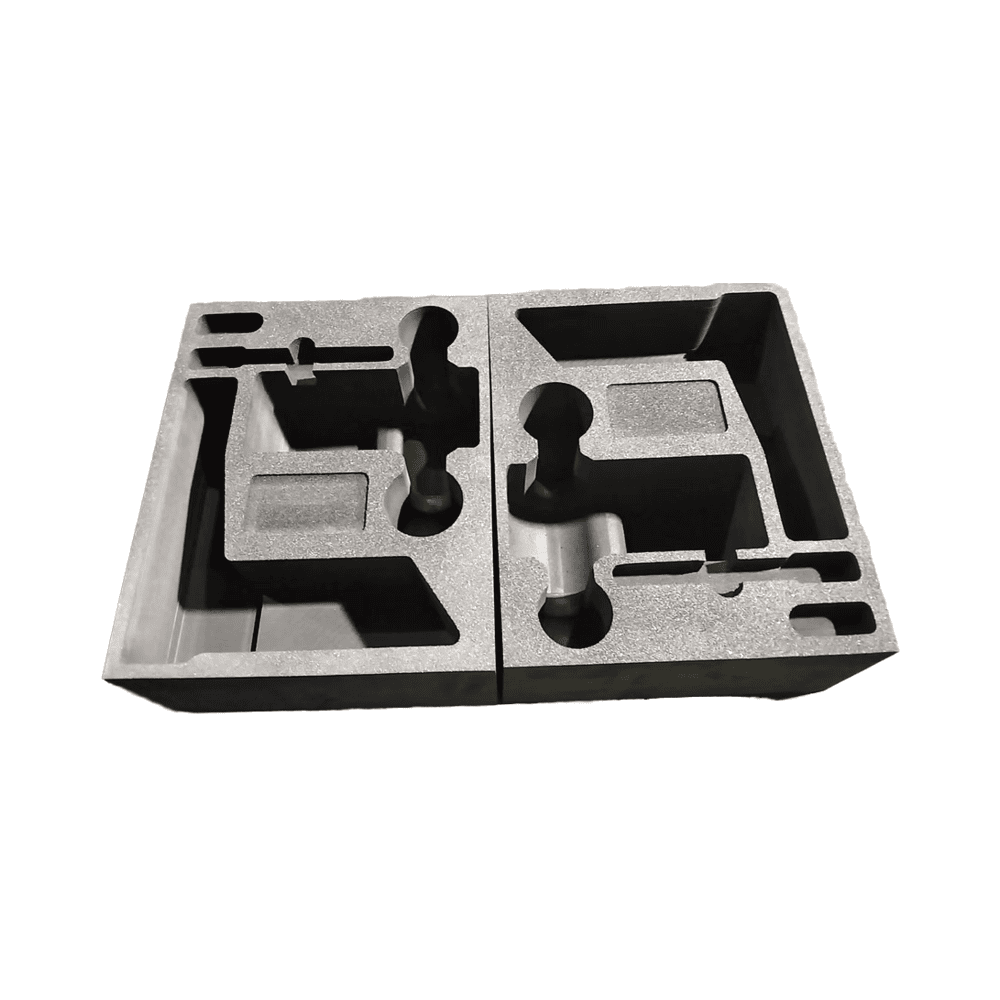
Navigating the complex landscape of epe foam packaging manufacturers in China requires a partner that bridges high-volume continuous extrusion with bespoke, micro-tolerance CNC fabrication. Mailong Packaging delivers comprehensive protective packaging architectures, unifying shock-absorbing expanded polyethylene (EPE) with dense, high-rebound Ethylene Vinyl Acetate (EVA) foam to solve your exact logistics drop-test challenges.
| Available Configurations | Continuous EVA/EPE Foam Rolls, Custom Extruded Planks, Multi-Cavity Die-Cut Inserts, L-Shape & U-Channel Edge Protectors |
| Standard & Custom Dimensions | Rolls: 0.5m × 100m, 1m × 50m | Planks: 1m × 1m, 1m × 2m | Inserts: Fully customized to product CAD STP/DXF files |
| Thickness & Density Spectrum | Thickness: 0.5mm to 100mm+ laminated | Foam Hardness: 20 to 90 Shore (18 kg/m3 to 65 kg/m3 EPE; high-density EVA) |
| Color & Additive Options | Pristine White, Deep Carbon Black, Custom Brand Colors, and Certified Pink Anti-Static (ESD) Formulations |
| Target Industrial Sectors | Precision Consumer Electronics, High-Gloss Furniture, Automotive Sub-Assemblies, Medical Diagnostic Hardware, Heavy Machinery |
| Mechanical Capabilities | Multi-axis CNC waterjet carving, precision steel-rule hydraulic stamping, adhesive-free thermal welding, and flame-retardant compounding |
Packaging Engineer’s Advice: Stop compromising your product with generic void fill. Settle for nothing less than custom-engineered cushioning. Inspect technical specifications on the official Mailong Packaging EVA FOAM product page, explore high-velocity inflatable alternatives on our Inflatable Air Column Wrap portal, or evaluate our heavy-duty protective solutions via our Heavy Duty Bubble Wrap technical guide.
Direct Technical Comparison: Manufacturing Architecture and Quality Controls
| Evaluation Vector | Tier-1 Integrated Manufacturer (Mailong Packaging Model) |
Regional Processing Converter (Mid-Tier Foam Die-Cutter) |
Trading Company / Broker (Commercial Export Agency) |
|---|---|---|---|
| Raw Resin Sourcing | 100% Prime virgin LDPE with certified MFI control | Mixed virgin and post-industrial regrind scrap | Unknown; sources from lowest open bidder |
| Plank Lamination Technology | Automated continuous hot-air thermal fusion (No glue) | Manual hot-melt glue or solvent adhesives | Outsourced to third-party laminating shops |
| Die-Cutting & Prototyping | In-house 5-axis CNC waterjet + high-speed laser tables | Manual clicker presses and wooden steel-rule dies | Subcontracts all sampling; 2-3 week sample lag |
| Anti-Static Control (ESD) | Internal permanent masterbatch (10^9–10^11 ohms) | Topical chemical spray (Rubs off in shipping) | No testing equipment; unverified pink dye only |
| Container Loading Efficiency | Advanced hydraulic roll baling & nested insert design | Standard loose hand stacking (High air waste) | Standard loading; customer pays for shipping air |
| Quality Traceability | Full ASTM testing logs: Density, compression, tear | Visual human check only; no mechanical labs | Zero testing capability; generic vendor paperwork |
Pros and Cons: Direct Chinese Factory Procurement vs. Domestic Western Converters
| Procurement Route | Documented Commercial Advantages (Pros) | Real-World Industrial Liabilities (Cons) |
|---|---|---|
| Direct Chinese Manufacturer (e.g., Mailong Packaging Partnership) |
|
|
| Domestic Western Foam Converters (Local Packaging Fabricators) |
|
|
Commercial Benefits and Inherent Material Limitations of EPE Foam
Every packaging engineer knows that no single cushioning material solves every distribution problem. Expanded polyethylene is the undisputed workhorse of modern logistics, but an honest technical audit requires understanding where it excels and where its physical boundaries lie.
The Real Protective Performance Payoffs:
- Supreme Compression Recovery (Non-Crushing): Under continuous static warehouse stacking or repeated dynamic drops, EPE foam retains over 90% of its original thickness. Unlike expanded polystyrene (EPS) which deforms permanently on impact, or paper pulp which crushes under humidity, closed-cell EPE absorbs shock and returns to shape, ensuring your product remains protected across multi-leg courier handoffs.
- Total Surface Defense on Class-A Finishes: Automotive bumpers, anodized aluminum laptop shells, and optical lenses are ruined by surface scuffing. EPE’s microscopic cellular walls are soft and non-abrasive. It cushions without scratching, eliminating the need for expensive secondary masking films.
- Immunity to Moisture and Environmental Chemicals: EPE foam absorbs less than 0.5% water by volume after 24 hours of total submersion. It resists mineral oils, aggressive chemical vapors, and bacterial fungal growth, making it the perfect substrate for long-haul maritime shipping through humid equatorial zones.
The Inherent Industrial Limitations:
- The Shipping Volume-to-Weight Penalty: EPE foam is fundamentally 98% trapped air and 2% solid polymer. Shipping un-cut, low-density foam rolls across the ocean means paying freight charges on empty air. Savvy procurement teams mitigate this by purchasing custom die-cut, nested kits that pack flat, or sourcing from factories equipped with high-compression roll balers.
- Thermal Melting Thresholds: Low-density polyethylene softens at temperatures above 80°C (176°F) and melts at approximately 110°C to 115°C. EPE foam cannot be used in high-temperature engine compartments or for thermal heat-sealing zones exceeding these limits. In such scenarios, crosslinked foams or silicone rubbers are required.
Who Needs High-Grade EPE Foam vs. Who Can Settle for Basic Bubble Wrap
Every commercial hardware or fulfillment budget must match cushioning performance to product fragility, weight, and transit severity. Sourcing custom EPE inserts from leading epe foam packaging manufacturers in China is transformative for high-value goods, while basic void fill suffices for lightweight commodities.
Industries That Must Invest in Custom EPE Foam Packaging:
- Precision Electronics & Telecommunications Hardware: Servers, network switches, medical monitors, and circuit boards containing heavy transformers and fine-pitch BGAs. Fragile silicon fractures when subjected to high-frequency transit vibration; custom-milled EPE end-caps suspend the chassis inside the outer corrugated carton, ensuring zero deceleration G-spikes reach delicate internal traces. For sensitive boards, integrate dedicated Anti Static Bubble Bags alongside custom EPE inserts.
- Heavy Automotive & Aerospace Components: Aluminum engine heads, turbochargers, instrument clusters, and precision sensors. Heavy parts pierce through cardboard and pop air bubble wrap within the first fifty miles of transit. Rigid 35 to 50 kg/m3 EPE foam blocks lock heavy metal assemblies in place with zero shifting.
- Luxury Consumer Hardware & High-End Cosmetics: Products where the unboxing experience directly defines brand equity. Clean, velvety die-cut EPE or high-density EVA trays elevate perceived value and showcase the product cleanly. Pair your internal foam inserts with exterior Custom Mailer Bags with Logo or durable Poly Mailer Shipping Bags for complete retail packaging harmony.
When Basic Bubble Wrap or Corrugated Paper Suffices:
- Low-Cost, Non-Fragile Commodities: If you are shipping plastic kitchenware, clothing, soft plush toys, or bulk hardware fasteners, investing in custom CNC-milled EPE foam inserts is financially wasteful. Lightweight goods are fully protected using standard Packing Tape BOPP Tape, simple Bubble Wrap Pouches, or sustainable Corrugated Cardboard Rolls. For eco-conscious fulfillment centers exploring paper void fill, evaluate operational metrics in our analysis of Bubble Wrap Alternatives and complete Eco Shipping Packaging systems.
5 Costly Mistakes Procurement Teams Make When Sourcing EPE Foam from China
Factory Floor Advisory: The “Chemical Glue Lamination” Disaster
The most common failure in budget EPE foam planks occurs when a converter bonds multiple 10mm foam sheets together using cheap, solvent-based contact adhesives or yellow neoprene glues rather than automated hot-air thermal fusion. When your shipping containers sit on ocean vessels crossing equatorial waters, container temperatures spike past 55°C (131°F). The cheap chemical solvent off-gases, turns gooey, and delaminates. Worse, the trapped solvent vapors cannot escape, attacking your product’s painted plastics, fogging optical displays, and leaving your goods smelling like industrial benzene upon customer arrival. Always insist that your Chinese manufacturer utilizes 100% adhesive-free hot-air thermal lamination for all multi-layer foam planks.
- Ordering by Nominal Thickness While Ignoring Density (kg/m3): Requesting a “50mm thick foam plank” without specifying density. A disreputable factory will extrude a highly expanded, ultra-light 18 kg/m3 foam that feels thick but collapses flat under the weight of a 15-kilogram product. Always mandate an exact density specification: e.g., 28 to 32 kg/m3 (±2 kg/m3) verified by volumetric mass test reports.
- Accepting Recycled Post-Industrial Scrap in Precision Trays: Sourcing from cheap converters that blend unwashed, degraded regrind factory scrap into their foam melt to save ten percent on raw resin invoices. Recycled scrap foam exhibits uneven cell walls, inconsistent density pockets, and hard un-melted polymer beads (hard gels) that will scratch high-gloss finished surfaces. Insist on 100% prime virgin LDPE resin certification for all critical contact surfaces.
- Failing to Account for Compression Creep in Long-Haul Logistics: Sizing foam cushioning based solely on initial drop tests while ignoring long-term static loading. If heavy products sit on warehouse pallets for six months, low-density foam experiences mechanical “creep”—a gradual, permanent reduction in thickness under sustained static pressure. When the box is finally shipped to a customer, the loose product rattles inside the carton, causing shock damage. Cushioning curves must account for both static stress and dynamic G-forces.
- Ignoring Draft Angles and Tooling Radius in Die-Cutting: Sending CAD files with knife-edge zero-radius internal corners and expecting a steel-rule die to punch them cleanly in 50mm thick foam. Thick foam compresses vertically under a hydraulic die-cutting blade, causing the side walls of deep cavities to bow inward (hour-glassing). Experienced engineers design minimum 3mm to 5mm internal corner radii or specify multi-axis CNC waterjet cutting for deep, vertical-wall cavities.
- Overlooking Electrostatic Decay Times on ESD Packaging: Purchasing pink “anti-static” EPE foam based solely on color without demanding a certified electrostatic decay test report. Unethical brokers simply add cheap red dye to standard foam, which has zero static-dissipative properties. Genuine ESD foam must comply with MIL-STD-3010C or EIA-541 standards, proving an electrostatic charge dissipation time of less than 2.0 seconds at 12% relative humidity.
Essential Sourcing Checklist: Auditing a Chinese EPE Foam Factory
Before issuing a master purchase order or releasing production deposits to any supplier among epe foam packaging manufacturers in China, require prospective factories to prove compliance across these four non-negotiable engineering benchmarks:
1. Verified Extrusion Infrastructure and Tandem Foaming Lines
Demand documented equipment lists and video verification of the extrusion floor:
- Do they operate modern tandem primary and secondary foaming extrusion lines with automated temperature controls to maintain tight closed-cell diameter uniformity?
- Do they utilize automated hot-air thermal lamination machines capable of bonding multi-layer planks up to 100mm+ thickness without toxic chemical glues?
- Review mechanical property standards governed by ASTM International: ASTM D3575 Flexible Cellular Materials Made From Olefin Polymers.
2. Multi-Axis Fabrication and Tooling Precision
Inspect the conversion and die-cutting workshops:
- Do they house high-speed CNC waterjet cutting machines that cut complex, deep-cavity geometries without the edge distortion of hydraulic stamping?
- Can they hold dimensional fabrication tolerances within ±0.5mm to ±1.0mm on custom-cut inserts?
- Do they provide rapid functional CAD prototypes (STP/DXF files converted to physical samples) within 3 to 5 business days?
3. Certified International Quality Management Systems
Ensure the facility operates under audited global manufacturing frameworks:
- Active certification under ISO 9001:2015 Quality Management Systems and ISO 14001 Environmental Management Systems.
- Comprehensive compliance verification: all foam materials must carry active third-party laboratory test certificates proving complete compliance with RoHS Directive 2011/65/EU and REACH (EC 1907/2006) Substances of Very High Concern (SVHC).
4. Total Packaging Integration & Logistics Packing Intelligence
A high-competence packaging manufacturer does not sell foam in isolation. They understand how foam inserts interface with corrugated master cartons, outer mailers, and palletized shipping containers. Partnering with a vertically integrated packaging leader like Mailong Packaging ensures that your custom EPE inserts, heavy-duty shipping cartons, and exterior protective wraps are engineered simultaneously, eliminating dimensional interference errors and maximizing container space utilization.
Expert Procurement Verdict: The Strategic Supply Chain Blueprint
In our professional assessment across decades of protective packaging fabrication and global supply chain consulting, the conclusion is absolute: sourcing directly from top-tier epe foam packaging manufacturers in China is the single most effective way to eliminate transit damage while slashing corporate packaging expenditures by up to 50%. Treating foam as a generic commodity purchased through local middlemen is an expensive operational blunder that invites shipping failures and inflated invoices.
Here is your clear, actionable procurement roadmap:
- Perform a Rigorous Drop-Test Audit: Define your product’s fragility threshold (maximum allowable G-force shock) and drop height (typically 36 to 48 inches per ISTA 1A/2A protocols). Use dynamic cushioning curves to calculate the exact foam density and thickness required to protect your product without over-packaging.
- Mandate 100% Adhesive-Free Thermal Lamination: Eliminate toxic off-gassing and delamination risks. Insist that all multi-layer planks and blocks are bonded using automated hot-air thermal fusion.
- Optimize for Shipping Cube Efficiency: Never pay to ship empty ocean container space. Work with your manufacturer to design nested inserts, interlocking end-caps, or specify high-compression roll packaging that maximizes container load densities.
- Partner Directly with Mailong Packaging: Eliminate trading brokers and uncalibrated converters by partnering directly with Mailong Packaging. Leveraging our advanced Dongguan extrusion and CNC fabrication facilities, comprehensive EPE and EVA hybrid material capabilities, and decades of international export pedigree, Mailong provides global enterprises with precision-engineered, cost-effective protective packaging that arrives on time, within budget, and built to withstand the harshest distribution networks on earth.
Frequently Asked Questions
Global supply chains prioritize epe foam packaging manufacturers in China due to vertical polymer supply integration, high-tonnage tandem extrusion capabilities, advanced CNC waterjet and laser die-cutting, and substantial cost advantages. Chinese manufacturers control the entire production chain from raw low-density polyethylene (LDPE) resin to multi-layer thermal lamination, delivering custom protective packaging at 30% to 50% lower unit costs than Western fabricators.
Expanded polyethylene (EPE) foam density ranges from 18 kg/m3 (1.1 lbs/cu ft) for lightweight surface protection and void fill up to 65 kg/m3 (4.0 lbs/cu ft) for heavy industrial machinery and automotive blocking. In most professional situations, electronic components and fragile glass assemblies perform best at 28 to 35 kg/m3, which delivers optimal shock absorption without permanent compression set.
Genuine permanent anti-static EPE foam incorporates internal conductive carbon black or non-migratory anti-static masterbatch additives during the raw resin extrusion melt. This maintains consistent surface resistivity between 10 to the 9th and 10 to the 11th ohms per square indefinitely. Topical anti-static sprays merely coat the exterior, rub off easily during shipping friction, and lose charge dissipation as humidity drops below 40%.
EPE (Expanded Polyethylene) is a lightweight, non-crosslinked closed-cell foam offering excellent multi-drop impact absorption, high chemical resistance, and 100% recyclability at an economical price point. EVA (Ethylene Vinyl Acetate) is a denser, crosslinked elastomeric foam with rubber-like rebound and higher tear resistance, making EVA superior for luxury display trays and repetitive tool inserts.
Authoritative References & Packaging Standards
- ASTM International: ASTM D3575 Standard Test Methods for Flexible Cellular Materials Made From Olefin Polymers
- International Safe Transit Association (ISTA): ISTA 1A, 2A, and 3A Packaged-Product Performance Testing Procedures
- International Organization for Standardization (ISO): ISO 9001:2015 Quality Management Systems – Requirements for Protective Packaging Converters