
In the logistics and electronics distribution sectors, Electrostatic Discharge (ESD) represents a silent, multi-billion-dollar threat. A fraction of a second of friction during transport can generate thousands of volts of static electricity, instantly rupturing internal microscopic circuits without leaving any external trace. Too many electronics hardware distribution teams make the catastrophic mistake of using standard pink or clear poly packaging, failing to realize that ordinary bubble cushions generate severe triboelectric charges during movement. True technical security demands specialized shielding materials, specifically designed to dissipate surface charges before they hit sensitive solder joints.

From our experience in material engineering, choosing the right physical defense layer is not just about cushion depth; it requires matching the exact electrical sensitivity of the hardware to its corresponding package architecture. This comprehensive, unfiltered guide breaks down the nine essential electronic components for use with anti-static bubble bags, analyzing why these specific semiconductors and circuit assemblies demand specialized dissipative packaging during storage and international shipping cycles.
Strategic Content Map
- 1. Strategic Matrix: Electronic Components & ESD Risk Index
- 2. The Technical Science Behind Anti-Static Bubble Insulation
- 3. 9 Vital Electronic Components for Use with Anti-Static Bubble Bags
- 4. Integrating Structural Foams and Secondary Shielding Architectures
- 5. Logistics and Engineering Procurement FAQs
- 6. Technical Reference Sources
1. Strategic Matrix: Electronic Components & ESD Risk Index
To provide immediate, actionable benchmarks for hardware logistics managers and warehouse coordinators, we have structured an analytical overview of components that strictly require static-free handling compared to their mechanical vulnerability profiles.
| Component Class | ESD Sensitivity Threshold (V) | Primary Physical Damage Risk | Mandatory Packaging Strategy |
|---|---|---|---|
| Assembled PCBA Boards | 100V – 500V | Trace bridging, micro-controller blowout | Dissipative bubble wraps with anti-static shielding |
| MOSFETs / Power Transistors | 50V – 200V | Gate oxide puncture, permanent short-circuit | Form-fitting dissipative anti-static cushioning pouches |
| Microprocessors & CPUs | <100V | Internal logic gate degradation, computational drift | High-density dissipative pouches inside rigid boxing |
| Memory Modules (RAM / Flash) | 100V – 300V | Bit alteration, permanent read/write data sector corruption | Multi-layer anti-static cushioning wraps |
| Laser Diodes & Optoelectronics | <50V | Optical facet degradation, emitter burnout | Ultra-sensitive anti-static customized padding pouches |
| CMOS Image Sensors | 150V – 400V | Pixel node death, horizontal sensor line interference | Anti-static shielding pouches paired with cleanroom bags |
| Solid State Drives (SSDs) | 200V – 600V | Controller firmware corruption, voltage regulator damage | Thick bubble cushioning or specialized anti-static mailers |
| LCD / OLED Display Panels | 300V – 1000V | Driver IC failure, glass fracture from physical shock | Heavy-gauge dissipative air bubble wraps & outer box cushions |
| RF Transceivers & IoT Modules | 100V – 500V | Impedance drift, permanent receiver sensitivity loss | Compact antistatic bubble pouch inserts |
2. The Technical Science Behind Anti-Static Bubble Insulation
A widespread point of confusion across procurement networks is the functional difference between anti-static pink bubble wrap, static-shielding metallic bags, and black conductive materials. True pink anti-static bubble packaging is coated or co-extruded with specialized antistatic surfactants, typically long-chain fatty amines or amides. These chemical compounds interact with atmospheric humidity to create a microscopic, uniform layer of moisture on the surface of the polyethylene film. This conductive moisture layer effectively prevents the generation of triboelectric charges caused by friction or contact with other surfaces during shipping.
However, it is vital to understand that pink anti-static bubble wrap does not create a Faraday cage. It stops static from building up on the package itself, but it cannot block external electrostatic fields. For raw, unmounted semiconductors, we recommend using these dissipative layers as a cushioning wrap surrounding an inner metalized static shielding layer. For fully populated circuit assemblies that have onboard ground planes, utilizing high-quality pink Air Bubble Wrap & Pouch setups provides excellent, all-in-one protection against both kinetic impacts and static buildup during transport.
3. 9 Vital Electronic Components for Use with Anti-Static Bubble Bags
1. Assembled Printed Circuit Board Assemblies (PCBAs)
Fully populated PCBAs are a complex mix of microcontrollers, copper traces, resistors, and capacitors. During parcel transport, the board can vibrate heavily against the walls of an outer box. If wrapped in ordinary plastic bubble cushion, the constant friction can build up a severe electrical charge across the copper planes. When a warehouse operator grabs the board, that static discharge travels through the components, causing immediate field failures. From our experience, keeping populated boards inside tailored anti-static bubble mailers prevents these combined physical and electrical stresses. For advanced hardware developers utilizing professional PCBA Assembly Services, using certified anti-static packaging is a mandatory requirement to ensure the boards arrive with their structural and electrical characteristics intact.
2. MOSFETs and Power Transistors
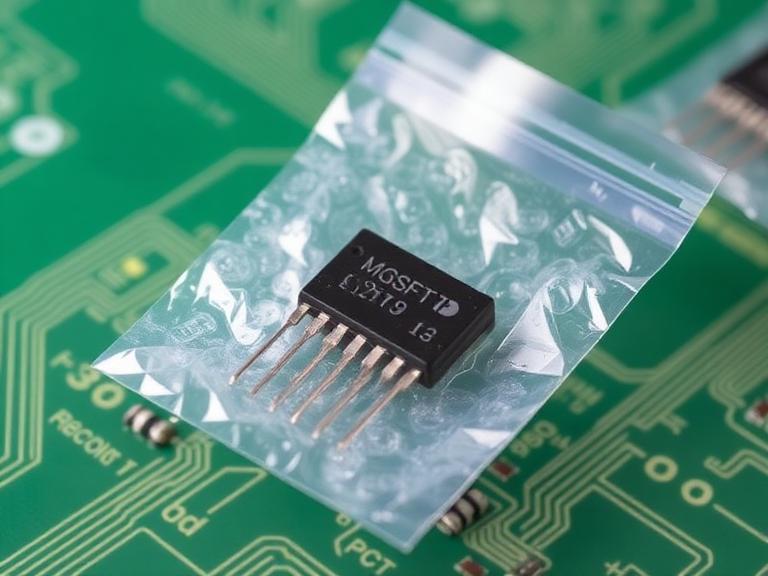
Metal-Oxide-Semiconductor Field-Effect Transistors (MOSFETs) are exceptionally vulnerable to electrostatic charges. The internal gate insulation of a MOSFET consists of a microscopic layer of silicon dioxide that can be permanently punctured by a static charge as low as 50 volts. Once this oxide layer is damaged, the transistor suffers a permanent short-circuit, ruining the power distribution system of the device. Because power transistors are compact and have sharp metal pins that can puncture thin poly bags, using heavy-gauge, puncture-resistant anti-static bubble pouches is required to safely isolate the pins while preserving the gate mechanics.
3. Central Processing Units (CPUs) and Microprocessors
Modern microprocessors feature billions of nanoscale transistors packed onto a tiny silicon die. These dense layouts make them highly sensitive to voltage surges. An ESD strike on a CPU pin does not just cause immediate failure; it can cause latent degradation. This hidden damage might pass initial quality checks but cause erratic computational errors or system crashes weeks later in the field. To prevent this, microprocessors must be housed in anti-static trays and wrapped tightly in high-performance dissipative air cushions to eliminate kinetic shifting and friction charges.
4. Memory Modules (DRAM, SRAM, and NVMe Flash)
Random Access Memory (RAM) sticks and solid-state storage chips use dense arrays of capacitors and floating-gate transistors to store binary data. A static discharge hitting the gold contact pins of a RAM stick can permanently corrupt firmware zones or destroy individual memory nodes, causing unrecoverable read/write errors. We recommend shipping these modular sub-assemblies in specialized, anti-static lined mailers to prevent static generation while providing clear structural support against bending forces.
5. Laser Diodes and Optoelectronic Transmitters
Optoelectronic components, such as high-speed fiber optic laser transmitters and infrared sensing arrays, have exceptionally low ESD tolerances, often failing at under 50 volts. A static charge can melt the delicate semiconductor junctions, causing immediate dark-line crystalline failures that reduce optical output or kill the emitter entirely. Because these components rely on precise alignment, using customized, dissipative bubble packaging protects them from physical alignment shifts while eliminating triboelectric charge hazards.
6. CMOS and CCD Image Sensors
CMOS digital camera sensors are dual-threat liabilities in logistics. They are highly sensitive to physical dust contamination and exceptionally vulnerable to static charges. Static charges across the glass cover plate can attract airborne dust particles and cause electrical breakdown across the underlying pixel architecture, leading to permanent dead pixels or signal lines across the image. Shipping these modules requires cleanroom-compatible anti-static bubble cushions that do not shed plastic particulate or release outgassing residue onto the optical elements.
7. Solid State Drives (SSDs) and Controller Sub-systems
Enterprise-grade solid-state drives rely on complex high-speed interface controllers and cache chips to manage rapid data transfers. While protected inside an external metal enclosure, the bare drive pins remain vulnerable to handling surges. A static charge passing through the SATA or NVMe interface can corrupt the controller’s internal routing tables, bricking the drive before it can even be partitioned. Utilizing thick, dedicated dissipative bubble bags provides the structural protection needed to safeguard the internal components from drop shocks and static fields.
8. LCD and OLED Display Panels
Digital display panels are physically fragile and electrically sensitive. The integrated driver integrated circuits (ICs) mounted along the thin borders of the glass substrates manage the voltage levels for millions of pixels. A static discharge moving across the glass surface can blow out these fragile edge ICs, resulting in permanent vertical or horizontal lines across the display. Using heavy-gauge antistatic cushion arrays protects the glass from flexing or shattering while dissipating static charges during cross-border logistics.
9. RF Transceivers and Wireless IoT Modules
Radio Frequency (RF) modules, such as Bluetooth, Wi-Fi, and 5G cellular chips, contain highly sensitive low-noise amplifiers (LNAs) designed to detect incredibly weak wireless signals. An ESD surge hitting the antenna pin can degrade or burn out the LNA, permanently reducing the module’s wireless range and signal integrity. Enclosing these compact modules in form-fitting antistatic bubble pouches isolates the RF inputs from triboelectric charge generation during shipping.
Protective Manufacturing Excellence by Mailong Packaging

Mailong Packaging Co., Ltd. was established in 2009. It is a reputed manufacturer and exporter of a wide range of world-class quality packaging materials, such as inflatable bubble and pillow film, air column rolls, air column bags, EPE and EVA FOAM, Poly Mailer, Stretch wrap, Bubble mailer, BOPP tape, and Corrugated box, which can prevent products from collision damage, attrition, and static in the process of logistics transportation, and have been exported to the oversea markets more than 30 countries.
From our experience, high-value components require a multi-layered approach to protection. We engineer our technical antistatic bubble films with stable, long-lasting surface resistivities ($10^{9}$ to $10^{11}$ ohms/sq) that resist degradation even in low-humidity environments. This provides electronics manufacturers worldwide with predictable, high-performance physical and electrical protection for their products.
4. Integrating Structural Foams and Secondary Shielding Architectures
For heavy industrial electronics, rackmount servers, or medical diagnostic hardware, anti-static bubble wrap alone may not provide enough structural support to prevent bottoming-out during drop impacts. In these situations, packaging engineers must design multi-material systems that combine lightweight air cushions with dense structural foams. For heavy, sharp-edged power supplies or cast-metal enclosures, we recommend pairing bubble wraps with custom-molded EPE FOAM profiles. This approach provides excellent compressive load distribution and structural protection without generating static during compression cycles.
Similarly, when shipping delicate laser optics, high-end avionics, or hand-held diagnostic instrumentation, internal components require firm positioning within a hard-shell case. Using anti-static, non-sloughing EVA FOAM inserts provides a clean, premium presentation while absorbing heavy vibrations. For highly sensitive electronic components for use with anti-static bubble bagsd configurations, wrapping the device in an inner dissipative layer and nesting it into a supportive Flexible PU FOAM matrix prevents structural shifting and friction-induced charges during air transport.
For high-volume distribution setups, such as shipping multi-pack cartons of consumer electronics or populated server chassis, warehouse teams must look at the entire pallet configuration. Secure the master cartons using high-yield Pallet Film wraps to prevent shifting during container shipping. For bulk logistics, replacing old-fashioned packing peanuts with clean, customized Inflatable Bubble Wrap or heavy-duty padded Bubble Mailer systems speeds up throughput while ensuring comprehensive static dissipation across your entire supply chain.
This strict material discipline mirrors the engineering standards seen in other high-performance safety industries. For example, just as professional aerospace operators rely on specialized Inflatable Landing Airbags to safely dissipate extreme kinetic energy during a landing, electronics logistics managers must use precise, surface-dissipative bubble bags to neutralize static fields, ensuring high-value payloads arrive completely undamaged.
5. Logistics and Engineering Procurement FAQs
What is the technical difference between pink anti-static bubble wrap and clear or grey shielding bags?
Pink anti-static bubble wrap is a low-charging material designed to prevent friction-based static generation on the package itself, but it does not block external electrical fields. Clear or grey static-shielding bags feature an embedded vacuum-metalized aluminum layer that acts as a Faraday cage, blocking external electrostatic fields. For optimal safety, sensitive components should be placed inside a shielding bag, which is then wrapped in pink anti-static bubble wrap for physical cushioning.
Do anti-static bubble bags lose their dissipative properties over time?
Yes. Traditional pink anti-static films rely on topical or internal chemical surfactants that bloom to the surface and interact with ambient humidity. Over extended storage periods—typically 12 to 18 months—or when exposed to extreme heat and airflow, these surfactants can degrade or evaporate, reducing the film’s anti-static performance. We recommend monitoring your inventory levels and verifying older stocks using a surface resistivity meter.
What surface resistivity range should procurement managers look for in certified ESD packaging?
According to international ESD standards, true static dissipative packaging must maintain a surface resistivity between $10^{5}$ and $10^{11}$ ohms per square. Any material registering above $10^{12}$ ohms per square is classified as an insulator and should never be used near sensitive electronic components for use with anti-static bubble bagsd setups.
Can pink anti-static bubble packaging be safely reused across multiple shipping cycles?
We advise against reusing anti-static bubble wrap for high-value or highly sensitive electronics. Physical wear, stretching, and surface contamination from dust, oils, or moisture can degrade the chemical surfactant layer, leading to unpredictable anti-static performance. To ensure consistent protection, always use fresh, certified dissipative materials for primary electronics packaging.
6. Technical Reference Sources
To support your quality control and logistics teams with verified industrial testing procedures and compliance standards, please consult the following primary reference platforms:
- Electrostatic discharge control and packaging validation guidelines: Electrostatic Discharge Association (EOS/ESD Association)
- International packaging testing standards for shock, vibration, and static dissipation: American National Standards Institute (ANSI) Portal
- Technical publications on semiconductor sensitivity thresholds and physics of static damage: Institute of Electrical and Electronics Engineers (IEEE) Xplore
- Comprehensive packaging design materials and industrial product portfolios: Protective Shipping Packaging Materials