Every warehouse director, e-commerce fulfillment manager, and packaging procurement engineer eventually confronts the same costly operational dilemma: either you over-engineer carton void fill by deploying thick, heavy-gauge plastic films that inflate your material cost per package, or you cut costs with ultra-thin films that pop under transit compression, resulting in damaged merchandise, customer chargebacks, and warehouse return chaos. In high-volume fulfillment, void fill is not an afterthought. Inflated polyethylene cushions are structural pneumatic shock absorbers. If you pack a five-kilogram power tool with standard fifteen-micron retail void film, the air chamber will rupture on the first sorting conveyor bounce. Conversely, packing soft apparel or boxed plush goods with premium thirty-micron industrial film burns operational margin on every parcel shipped. Learning how to choose the right air pillow film thickness requires moving past vague supplier descriptions and analyzing real polymer physics: tensile yield strength, dart drop impact resistance, material elongation, and carton void mechanics. As automated packaging specialists, blown-film extrusion technicians, and industrial protective packaging manufacturers at Mailong Packaging, we test burst pressures, measure gas retention rates, and optimize S-curve inflation profiles daily. Here is our practitioner-level evaluation of how to choose the right air pillow film thickness across diverse product categories, ensuring your shipments arrive intact while keeping material costs strictly under control.
Quick Answer: How to Choose the Right Air Pillow Film Thickness
To choose the right air pillow film thickness, match your product’s deadweight, geometry, and shipping cycle to one of four calibrated gauge tiers: (1) 13 to 15 Microns (0.5 to 0.6 mil) HDPE: Engineered for ultra-lightweight void fill under 1.5 kg, such as apparel, plush toys, retail-boxed textiles, and footwear; (2) 18 to 20 Microns (0.7 to 0.8 mil) HDPE/LLDPE: The universal workhorse tier for general e-commerce goods between 1.5 kg and 5.0 kg, including cosmetics, vitamins, packaged toys, and consumer lifestyle accessories; (3) 25 Microns (1.0 mil) Heavy-Duty Film: Required for dense, semi-fragile products weighing 5.0 kg to 10.0 kg, such as small electronics, canned goods, books, and boxed kitchenware with moderate corners; and (4) 30 to 35+ Microns (1.2 to 1.4 mil) or Multi-Chamber Air Columns: Mandatory for heavy industrial hardware, automotive components, and fragile glass/liquids over 10 kg, where high compressive loads demand high burst thresholds. For soft goods and boxed toys, deploying cost-effective solutions like Mailong Packaging Air Pillow Packaging for Toys allows fulfillment centers to minimize plastics usage while arresting product migration inside cartons.
Article Directory
- What It Is: Understanding Air Pillow Film Gauges, Microns, and Mils
- Quick Summary Table: Film Thickness Matrix by Product Category
- Polymer Mechanics: HDPE vs. LDPE vs. Multi-Layer Co-Extrusion
- The 4 Core Thickness Tiers and Their Real-World Product Applications
- Featured Packaging Spotlight: Mailong Packaging Air Pillow Packaging for Toys
- Direct Technical Comparison: Film Gauge, Puncture Resistance, and Load Limits
- Pros and Cons: Ultra-Thin Films (13–18 μm) vs. Heavy-Gauge Films (25–35+ μm)
- Commercial Realities: The Hidden Cost of Under-Gauging and Over-Gauging
- Who Should Use Standard Air Pillows vs. Who Needs Heavy-Duty Foam or Columns
- Costly Mistakes Warehouse Operators Make with Air Pillow Films
- Essential Sourcing Checklist: Auditing an Air Pillow Film Manufacturer
- Expert Procurement Verdict: The Sustainable Cushioning Blueprint
- Frequently Asked Questions
- Authoritative Standards & Packaging Industry References
What It Is: Understanding Air Pillow Film Gauges, Microns, and Mils
To accurately choose the right air pillow film thickness, you must understand how flexible packaging films are measured and how physical thickness translates into dynamic load protection. In the international packaging sector, film thickness is measured in microns (μm), where one micron equals one-thousandth of a millimeter ($0.001\text{ mm}$). In North American markets, film thickness is frequently expressed in mils or gauge, where one mil equals one-thousandth of an inch ($0.001\text{ in}$), equivalent to $25.4\text{ microns}$, and one mil equals 100 gauge.
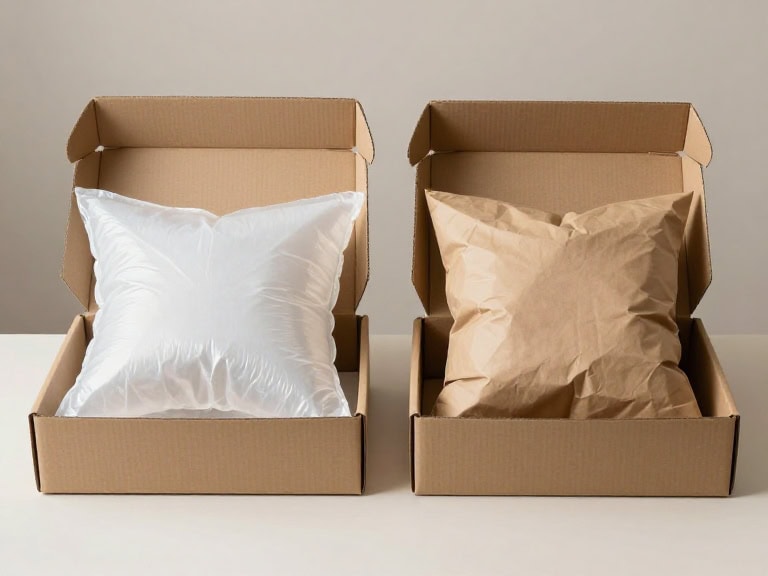
When an uninflated roll of Air Pillow Film feeds through an on-demand tabletop air cushion machine, two micro-thin polymer webs are inflated via an internal air blower nozzle and fused together along a continuous longitudinal track using a heated sealing element. The resulting air pocket relies entirely on the tensile strength of the extruded plastic film and the molecular integrity of the thermal weld seam to trap compressed air under dynamic shipping stress.
In our testing across automated drop towers, film thickness directly governs three mechanical performance metrics:
- Tensile Yield and Break Strength: Governed by standards such as ASTM D882 Standard Test Method for Tensile Properties of Thin Plastic Sheeting. Thicker films resist the hydrostatic hoop stress generated when an external force squashes the inflated pillow against the rigid wall of a corrugated outer box.
- Puncture Resistance (Dart Drop Impact): Governed by ASTM D1709 Free-Falling Dart Impact Testing. Thin films stretch and tear easily when contacted by semi-pointed object corners (such as the sharp edges of hardbound book covers or molded blister packaging), while thicker films distribute localized point stress across a wider molecular matrix.
- Gas Permeation and Creep Rate: Under sustained compressive stack loads inside palletized freight containers, air slowly escapes across the amorphous regions of the polyethylene film. Thicker films provide a denser tortuous path for nitrogen and oxygen molecules, preserving pillow volume throughout extended multi-week intermodal shipping cycles.
Quick Summary Table: Film Thickness Matrix by Product Category
| Film Thickness (μm / mil) | Primary Polymer Base | Recommended Max Item Weight | Optimal Product Categories | Primary Packaging Function |
|---|---|---|---|---|
| 13 – 15 μm (0.5 – 0.6 mil) | HDPE Virgin / Recycled Blend | Up to 1.5 kg (3.3 lbs) | Apparel, footwear, plush toys, textiles, boxed tissues | Top-fill void fill; movement arrest |
| 18 – 20 μm (0.7 – 0.8 mil) | HDPE / LLDPE Co-ex | 1.5 kg to 5.0 kg (3.3 – 11 lbs) | Cosmetics, pharmaceutical bottles, retail boxed toys, vitamins | General void fill; light shock absorption |
| 25 – 28 μm (1.0 – 1.1 mil) | LLDPE / LDPE Multi-layer | 5.0 kg to 10.0 kg (11 – 22 lbs) | Small power tools, books, kitchenware, boxed electronics | Side blocking, bracing, medium cushioning |
| 30 – 35 μm (1.2 – 1.4 mil) | Multi-layer Co-ex with Metallocene | 10.0 kg to 18.0 kg (22 – 40 lbs) | Heavy auto parts, machine fittings, bulk canned goods | Heavy-duty corner blocking and bracing |
| 45+ μm (Air Column Bags) | Co-extruded PE/PA (Nylon Barrier) | 15.0 kg to 35.0+ kg (33 – 77+ lbs) | Unboxed glassware, wine bottles, high-end laptops, servers | Complete structural 360-degree impact isolation |
Polymer Mechanics: HDPE vs. LDPE vs. Multi-Layer Co-Extrusion
You cannot effectively choose the right air pillow film thickness without examining the polymer chemistry extruded into that film. Two air pillows of identical twenty-micron thickness will exhibit wildly divergent burst thresholds if one is made from basic Low-Density Polyethylene (LDPE) and the other is blown from high-purity High-Density Polyethylene (HDPE) with metallocene catalysts.
In most professional situations, fulfillment centers choose between three primary resin formulations:
- High-Density Polyethylene (HDPE): The global benchmark for void fill. HDPE features a highly crystalline, tightly packed molecular structure. This gives the film exceptional tensile modulus, high stiffness, and characteristic crinkly feel. The major advantage of HDPE is that it allows processors to down-gauge: a 15-micron HDPE film delivers equal or superior burst resistance under top-fill compression compared to a 22-micron generic LDPE film. It holds air exceptionally well and runs smoothly through high-speed automated tabletop inflation machines.
- Low-Density Polyethylene & Linear Low-Density (LDPE / LLDPE): LDPE has extensive short- and long-chain polymer branching. The film is soft, silent, highly transparent, and possesses significant elasticity. While pure LDPE stretches and deforms under heavy deadweights, incorporating LLDPE (Linear Low-Density Polyethylene) provides superior tear propagation resistance. If your products have blunt, slightly protruding edges, LLDPE blends stretch around the corner without puncturing. However, to achieve equivalent load-bearing capacity, LLDPE requires a 20% to 30% thicker gauge than HDPE.
- Multi-Layer Co-Extruded Barrier Films (PE/PA): For high-stakes transit, single-layer films are insufficient. Multi-layer co-extrusion sandwiches a layer of Polyamide (Nylon) or EVOH gas barrier between protective polyethylene skins. This structure prevents air migration, allowing high-pressure cushions to stay fully pressurized for months during international container freight. This multi-layer technology is the foundation of structural Air Column Bags.
The 4 Core Thickness Tiers and Their Real-World Product Applications
Tier 1: 13 to 15 Microns (0.5 to 0.6 mil) – The Ultra-Lightweight Void Fill
In our testing across high-volume fashion and apparel fulfillment centers, using thick packaging film on non-fragile merchandise is an inexcusable waste of operational budget. When packing soft goods, hoodies, t-shirts, boxed footwear, or plush toys, the product itself is virtually immune to shock damage. The sole engineering objective of the air pillow is void fill: occupying empty headspace inside the corrugated shipper box so the carton flaps do not cave in when stacked onto pallets under stretch film tension.
A 13 to 15-micron HDPE film provides exceptional yield per roll (often exceeding 1,500 to 2,000 linear meters per roll), minimizing roll-change downtime on the packing line. It crushes easily during package unpacking, generating minimal plastic mass for consumer disposal. If your average package weight is under 1.5 kilograms and contains zero sharp edges, standardizing on a 15-micron film cuts material costs by up to 35% compared to standard retail gauges. For envelope shipments, pairing lightweight items with an exterior Poly Mailer or cushioned Bubble Mailer provides even faster packing throughput.
Tier 2: 18 to 20 Microns (0.7 to 0.8 mil) – The E-Commerce General Purpose Workhorse
If your warehouse fulfills a diverse, unpredictable mix of retail merchandise—such as health supplements, cosmetics, packaged board games, non-perishable food boxes, and home goods—managing six different film thicknesses at each packing station is a logistical nightmare. The 18 to 20-micron tier represents the universal sweet spot for modern e-commerce logistics.
At 20 microns, an HDPE/LLDPE blend offers balanced tensile yield and elongation. It supports package weights up to 5.0 kilograms (11 lbs) and withstands standard sorting drops from automated warehouse divert gates without bursting. It provides enough structural cushion to absorb horizontal shock pulses during parcel sorting while providing reliable top-fill void arrest. When procurement teams ask us what single thickness to standardize across a multi-category fulfillment center, we recommend an 18 to 20-micron HDPE film as the safest, most commercially viable default baseline.
Tier 3: 25 to 28 Microns (1.0 to 1.1 mil) – Medium Cushioning & Heavy Retail Goods
Once individual product weight exceeds 5 kilograms, the kinetic energy transferred during a transit drop increases exponentially ($E_k = \frac{1}{2}mv^2$). When a carton drops from a delivery truck bed onto concrete, a heavy item acts like an internal battering ram. Standard 15 or 18-micron air pillows will pop instantly under the sudden hydraulic pressure surge.
The 25-micron gauge introduces substantial puncture resistance and compressive fatigue strength. It is specifically engineered for:
- Dense, heavy paper goods (such as multiple hardbound books, catalogs, or stationery sets).
- Packaged countertop electronics (coffee makers, blenders, toaster ovens) that already possess internal cardboard pulp trays but require side blocking and bracing inside an outer shipping carton.
- Small metal hardware kits, plumbing valves, and automotive aftermarket retail boxes.
- Boxed jar sets, honey jars, and gourmet condiments where the primary retail jar is cushioned, but the shipper box requires rigid perimeter bracing to prevent carton crushing.
4. Tier 4: 30 to 35+ Microns (1.2 to 1.4 mil) – Heavy-Duty Industrial Transit
For heavy-duty applications spanning industrial B2B distribution, machined castings, heavy electric motors, and cross-border export freight, standard void fill pillows become structural bracing elements. At 30 to 35 microns, films are typically engineered with multi-layer co-extruded metallocene polyethylene to deliver maximum dart impact ratings exceeding 400 grams.
These heavy-gauge pillows are inflated to higher working pressures, creating stiff pneumatic blocks that wedge heavy products firmly into the center of a double-wall corrugated box. However, commercial judgment must be exercised here: once product weight exceeds 15 to 20 kilograms, or if the product features exposed, sharp un-machined metal burrs, all air pillows reach their physical limits. In such heavy-duty industrial scenarios, continuing to increase film gauge becomes cost-ineffective; you must transition to structural Inflatable Air Column Wrap, heavy fabricated EPE Foam Sheets, or rigid molded inserts.
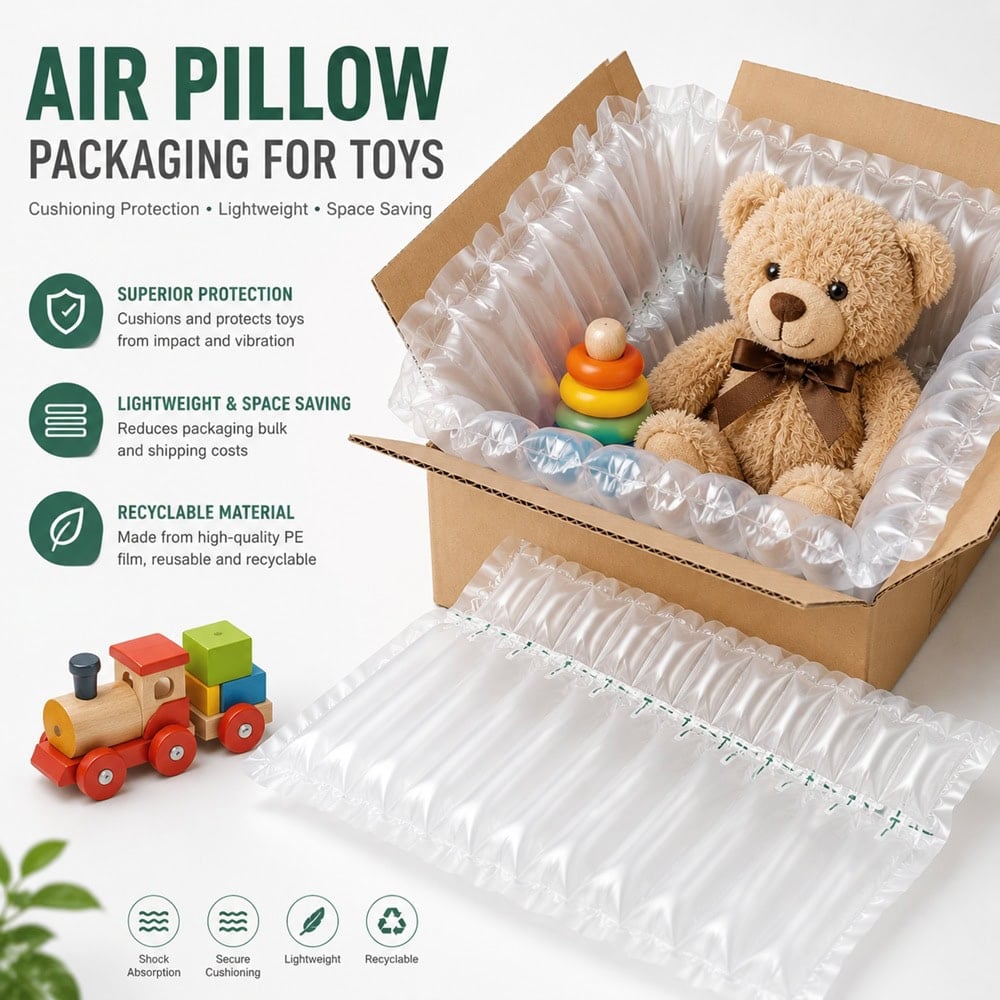
Enterprise Packaging Spotlight: Mailong Packaging Air Pillow Packaging for Toys
Engineered specifically to solve product migration and corner crushing in consumer goods fulfillment, Mailong Packaging Air Pillow Packaging for Toys delivers high-yield, cost-effective cushioning tailored for toy manufacturers, consumer electronics brands, and e-commerce distribution centers.
| Material Specification | High-Grade Virgin HDPE (High-Density Polyethylene) for maximum tensile rigidity |
| Key Performance Feature | High burst-pressure seal integrity engineered to arrest internal product movement |
| Thickness Options | Custom calibrated gauges (13 μm, 15 μm, 18 μm, and 20 μm tailored to package mass) |
| Low MOQ Flexibility | Low 10-Roll Minimum Order Quantity (MOQ) supporting agile warehouse scaling |
| Fast Production Lead Time | Rapid 3 to 7 Days factory turnaround with export dispatch via Shenzhen Port |
| International Trade Harmonization | HS Code: 3923900000 (Certified export-grade protective plastics) |
Packaging Engineer’s Advice: Stop overpaying for generic packaging distributors. Source factory-direct rolls on the official Air Pillow Packaging for Toys portal, explore high-volume manufacturing via leading Bubble Wrap Manufacturers China, or discover sustainable solutions in our Eco Shipping Packaging catalog.
Direct Technical Comparison: Film Gauge, Puncture Resistance, and Load Limits
| Film Gauge Specification | Dart Drop Impact (ASTM D1709) | Tensile Break Strength (ASTM D882) | Elongation at Break | Max Recommended Static Load | Relative Material Cost Index |
|---|---|---|---|---|---|
| 13 – 15 μm HDPE | 120 – 150 grams | ≥ 32 MPa (Machine Direction) | 150% – 250% | ≤ 1.5 kg per cushion quadrant | Baseline ($) |
| 18 – 20 μm HDPE | 180 – 230 grams | ≥ 38 MPa (Machine Direction) | 250% – 350% | ≤ 5.0 kg per cushion quadrant | +25% to +35% ($$) |
| 25 μm LLDPE/HDPE | 280 – 340 grams | ≥ 42 MPa (Machine Direction) | 400% – 550% | ≤ 10.0 kg per cushion quadrant | +60% to +75% ($$$) |
| 35 μm Multi-Layer Co-ex | 420 – 500+ grams | ≥ 48 MPa (Machine Direction) | 500% – 650% | ≤ 18.0 kg per cushion quadrant | +110% to +140% ($$$$) |
Pros and Cons: Ultra-Thin Films (13–18 μm) vs. Heavy-Gauge Films (25–35+ μm)
| Film Category | Operational & Economic Advantages (Pros) | Technical & Practical Liabilities (Cons) |
|---|---|---|
| Ultra-Thin Film Gauges (13 to 18 Microns) |
|
|
| Heavy-Gauge Film Gauges (25 to 35+ Microns) |
|
|
Commercial Realities: The Hidden Cost of Under-Gauging and Over-Gauging
Every commercial procurement manager is pressured to reduce operational expenditures. When analyzing packaging budgets, it is tempting to look at an Excel spreadsheet and mandate an immediate transition across all packing stations from 20-micron film down to 13-micron film, capturing an immediate 30% reduction in film roll costs. In the real world of e-commerce fulfillment, blind down-gauging is often a catastrophic false economy.
Consider the complete financial ledger of a shipping failure:
- If an under-gauged 13-micron air pillow bursts inside a shipping carton carrying a $120 consumer electronic item, the product shifts inside the box during transit, impacts the carton wall, and shatters.
- Your business loses the cost of the damaged item, absorbs round-trip reverse logistics freight ($15 to $25), pays warehouse labor to process the return ($8 to $12), and risks a permanent loss of customer lifetime value (LTV).
- To recover the financial loss of a single $120 damaged shipment, you must ship hundreds of packages on the cheaper film without incident just to break even.
Conversely, blind over-gauging is equally destructive to profitability. If your facility ships 50,000 orders of soft apparel, footwear, and plush toys every month, wrapping those items in 30-micron heavy-duty film wastes tens of thousands of dollars annually in unnecessary polymer resin. The strategic path is dynamic SKU-based gauge allocation: equipping standard packing lines with 15 to 18-micron films for lightweight and soft goods, while routing heavy, dense, or corner-heavy SKUs to dedicated packing stations running 25-micron or specialty protective cushioning.
Who Should Use Standard Air Pillows vs. Who Needs Heavy-Duty Foam or Columns
A frequent mistake made by warehouse operations teams is attempting to force air pillows into applications where they are physically unqualified to perform. Air pillows are engineered for void fill and position stabilization; they are not universal structural armor.
When Air Pillows Are the Optimal Choice:
- Carton Headspace Void Fill: Filling the empty 2 to 4 inches of space between the top of your product box and the closing flaps of an outer corrugated master shipper.
- Side Migration Prevention: Wedging lightweight to medium-weight products (under 8 kg) into the center of a box so they cannot slide laterally during rough conveyor handling.
- Boxed Merchandise Protection: Items that already possess primary protective packaging (such as a toy sealed inside a rigid cardboard display box) and merely require blocking inside an outer shipping carton.
When You Must Upgrade to Specialized Protective Alternatives:
- Unboxed, Highly Fragile Glassware and Ceramics: Standard air pillows have flat profiles that leave vulnerable contact gaps. For fragile ceramics, continuous surface wrapping using Inflatable Bubble Wrap or Heavy Duty Bubble Wrap is non-negotiable.
- Direct Bottle & Liquid Container Protection: Shipping wine bottles, olive oil, or chemical jugs requires multi-chambered, independent air cylinders. If one chamber punctures, adjacent chambers remain pressurized. You must deploy engineered Air Column Bags.
- Extreme Heavy Machinery & Sharp Sheet Metal: Components weighing over 20 kilograms with unrounded metal flanges will slice through even 35-micron plastic cushions. These applications demand high-density fabricated closed-cell foam, such as EPE FOAM, resilient EVA FOAM, or custom-cut Flexible PU FOAM. Compare structural cushioning materials in our guide to Bubble Wrap Alternatives.
Costly Mistakes Warehouse Operators Make with Air Pillow Films
Factory Floor Warning: The “Over-Inflation Burst” Paradox
The most common mistake packagers make is inflating air pillows to 100% rigid capacity like firm balloons. A rock-hard air pillow has zero shock-absorption capability. When a package is dropped, the trapped air cannot compress or shift; instead, the dynamic shock wave spikes internal hydrostatic pressure instantly past the tensile yield point of the polymer, rupturing the seal. Always calibrate your machine to inflate pillows to 70% to 80% volume. A properly inflated air pillow should have visible give when squeezed, acting as an elastic pneumatic shock absorber rather than a rigid balloon.
- Mismatched Sealing Temperature on On-Demand Machines: Running high-speed inflation machines without adjusting heat-sealing temperature when switching film thicknesses. If you transition from 15-micron film to 25-micron film without increasing the sealing block temperature, the thicker plastic will not achieve full polymer melt flow, resulting in cold, weak weld seams that unzip under transit pressure. Always perform a manual peel-test on your first inflated chain every morning.
- Ignoring Carton Void Ratio Dynamics: Attempting to use small 100 × 200 mm air pillows to fill massive 8-inch voids inside oversized cartons. Using dozens of tiny pillows to fill a cavernous void allows the product to tunnel between the cushions during transit vibrations, eventually contacting the outer box wall. For large voids exceeding 4 inches, deploy wide multi-chamber quilt pillows or large-format 200 × 200 mm cushions.
- Sourcing Unstabilized Films for Long-Haul Export Freight: Purchasing cheap, unbranded single-layer polyethylene films for products undergoing 45-day ocean container transit. Extreme temperature swings inside metal shipping containers (often reaching 60°C / 140°F in tropical waters) accelerate molecular gas migration across thin polyethylene, resulting in fully deflated pillows by the time the vessel docks at its destination port.
- Failing to Account for Air Cargo Pressure Drops: Packing parcels at sea-level facilities and shipping them via unpressurized or semi-pressurized air freight. As aircraft climb to cruising altitude, ambient atmospheric pressure drops. Air pillows inflated tightly at sea level expand significantly at high altitude, blowing out heat seals mid-flight. Always reduce inflation volume for air cargo shipments.
Essential Sourcing Checklist: Auditing an Air Pillow Film Manufacturer
Before issuing a bulk purchase order or signing an annual supply contract for air cushion films, require your prospective flexible packaging manufacturer to demonstrate verified compliance across these four operational benchmarks:
1. Verified Dart Drop and Tensile Data Sheets
Never buy film based solely on advertised nominal thickness. Demand certified laboratory test reports conducted according to recognized international testing standards:
- ASTM D1709 Dart Impact Resistance: Verifying that impact failure thresholds match your minimum product mass requirements.
- ASTM D882 Tensile Strength and Elongation at Break: Confirming the film will stretch elastically under dynamic drop shock without brittle shattering.
- Transit simulation verification in accordance with International Safe Transit Association (ISTA) 3A Packaged-Product Shock and Vibration Protocols.
2. Roll Winding Uniformity and Gauge Consistency
Inspect sample rolls on your shop floor. Low-quality extrusion lines produce films with severe gauge bands (where one edge of the roll is 14 microns and the opposite edge is 21 microns). Thickness variance causes the film to track diagonally inside tabletop inflation machines, wrinkling across the heat-sealing belt and causing intermittent air leakage. Settle for nothing less than a guaranteed gauge tolerance of ±5% across the entire web width.
3. Universal Core and Machine Compatibility
Ensure the manufacturer’s roll core dimensions, perforation pitch, and micro-air channel geometry are compatible with your existing machine fleet. High-quality manufacturers provide universal roll configurations that run smoothly across leading tabletop inflators without requiring proprietary, chipped RFID lockouts that force you into overpriced closed-loop film contracts.
4. Total Protective Packaging Integration
A high-competence packaging partner does not sell air pillows in a vacuum. They understand how air pillows interact with secondary packaging lines. Whether you need protective wraps from certified Packing Foam Sheets Suppliers, specialized Flexible Polyurethane Foam Manufacturers, heavy-duty pallet stabilization via high-stretch Pallet Film, or branded consumer mailers using Custom Mailer Bags with Logo, an integrated partner ensures your packaging ecosystem works seamlessly together.
Expert Procurement Verdict: The Sustainable Cushioning Blueprint
In our professional assessment across decades of automated packaging line integration, learning how to choose the right air pillow film thickness is the single fastest way to balance packaging sustainability, transit damage reduction, and fulfillment profitability. Air pillows remain the most lightweight, cost-effective void fill technology ever engineered—provided you respect the physical limitations of the polymer gauge.
Here is your clear, actionable procurement roadmap:
- Conduct a Full SKU Weight and Geometry Audit: Segment your shipping catalog by deadweight and edge sharpness. Stop using one single arbitrary film gauge for everything your warehouse ships.
- Deploy 13 to 15-Micron HDPE for Soft and Lightweight Goods: For apparel, textiles, soft toys, and boxed items under 1.5 kg, standardize on ultra-thin 15-micron HDPE. You will slash plastic consumption, maximize roll yield, and protect your margins without increasing damage rates.
- Lock in 18 to 20-Micron HDPE as Your Universal Baseline: For mixed retail e-commerce parcels weighing between 1.5 kg and 5.0 kg, standardize on 20-micron film. It delivers the optimal commercial balance of burst resistance, puncture tolerance, and machine running speed.
- Reserve 25 to 35-Micron Gauges for Heavy Bracing: When shipping dense books, small power tools, or canned goods up to 10 kg, step up to heavy-duty 25-micron films. If items exceed 15 kg or feature unrounded metal corners, transition immediately to heavy-duty air column bags or fabricated EPE/EVA foam inserts.
- Partner with a Verified Direct Manufacturer: Eliminate trading middlemen by sourcing directly from an established extrusion and converting specialist like Mailong Packaging. With flexible order quantities, rapid 3 to 7-day factory lead times, and certified quality controls, we ensure your fulfillment lines run at peak efficiency with zero shipping failures.
Frequently Asked Questions
To choose the right air pillow film thickness, you must balance individual product weight, edge sharpness, transit vibration, and carton void volume. For light non-fragile items under 1.5 kg (such as soft apparel, boxed toys, and plush goods), an ultra-light 13 to 15 micron HDPE film provides sufficient void fill. For mixed retail and general consumer goods up to 5 kg, 18 to 20 microns is the universal standard. Heavier mechanical parts, dense hardware, or books exceeding 5 kg require 25 to 35 micron heavy-gauge film to prevent burst failure under transit compression.
High-Density Polyethylene (HDPE) provides higher tensile rigidity, crinkle resistance, and puncture strength per unit thickness, allowing processors to down-gauge to 15 to 20 microns while retaining air retention. Low-Density Polyethylene (LDPE) is softer, highly elastic, and stretches under dynamic impact, but requires a thicker gauge (typically 25 to 40 microns) to prevent premature rupture under equivalent shipping loads.
No. Air pillows are engineered primarily for top-fill and side void filling—preventing movement within a corrugated carton. They lack the localized multi-point impact absorption required for direct surface protection of unboxed ceramics, glassware, or heavy bottles. For direct wrapping of fragile goods, inflatable bubble wrap, air column bags, or fabricated foam sheets must be specified.
Deflation stems from three primary factors: micro-leakage caused by improper heat-sealing temperature on the air cushion machine, mechanical pinhole puncturing from product abrasion, or natural gas permeation across single-layer polyethylene over extended transit periods. In unpressurized air cargo, atmospheric pressure drops cause air cushions to expand, stressing seals and causing bursts if pillows were over-inflated at ground level.
Authoritative Standards & Packaging Industry References
- ASTM International: ASTM D1709 Standard Test Methods for Free-Falling Dart Impact Resistance of Plastic Film
- International Safe Transit Association (ISTA): ISTA 3A General Simulation Performance Testing for Packaged-Products Distributed Through Parcel Delivery Systems
- ASTM International: ASTM D882 Standard Test Method for Tensile Properties of Thin Plastic Sheeting and Flexible Polymer Films