If you ship furniture, glass, doors, windows, appliances, framed products, or other goods with exposed edges, foam corner protectors can prevent a surprisingly expensive category of damage. The best place to buy them depends on how many you need, the shape and weight of your product, and whether standard protectors actually fit your packaging line.
For occasional shipments, a packaging retailer or marketplace can be convenient. For recurring orders, unusual dimensions, or fragile products with high damage costs, we recommend working directly with a foam packaging manufacturer. The lowest unit price is rarely the whole story: fit, compression performance, consistency, packing speed, and freight costs all influence the real cost per protected shipment.
Where Should You Buy Foam Corner Protectors for Shipping?
Quick Answer: The five most practical places to find foam corner protectors for shipping are:
- Packaging supply companies for standard products and repeat purchases.
- Online marketplaces for small quantities and quick price comparisons.
- Foam manufacturers for custom sizes, materials, and bulk production.
- Industrial and shipping distributors for business procurement and consolidated orders.
- Specialist protective packaging providers for engineered solutions and demanding products.
Our recommendation: Buy standard corner protectors from a distributor when the dimensions fit and the order is modest. For repeat shipments, fragile products, or custom packaging requirements, request samples and a specification-based quote from a manufacturer.
| Place to buy | Best use case | Main advantage | Potential limitation |
|---|---|---|---|
| Packaging supply companies | Routine shipping and standard sizes | Convenient replenishment and product selection | Custom designs may be limited |
| Online marketplaces | Small orders, samples, or price discovery | Fast comparison of vendors and quantities | Product specifications and consistency can vary |
| Foam manufacturers | Bulk orders and customized protection | Control over material, geometry, and production specification | May require minimum quantities or lead time |
| Industrial distributors | Business purchasing and consolidated supplies | Procurement support and broader packaging inventory | Less direct control over manufacturing details |
| Specialist protective packaging providers | Fragile, high-value, or complex products | Application-focused packaging design | Engineering or design work can increase upfront cost |
What Are Foam Corner Protectors for Shipping?
Foam corner protectors are cushioning components placed over or around the vulnerable corners and edges of a product before it is packed into a carton, crate, or other shipping container. Their job is to absorb or distribute impact energy, reduce direct contact with packaging walls, and help prevent dents, chips, scratches, and edge deformation.
They are commonly made from expanded polyethylene (EPE), expanded polypropylene (EPP), polyurethane foam, or other cushioning materials. The material and geometry should match the product’s weight, corner shape, fragility, and expected shipping conditions.
How do foam corner protectors work?
During handling, a package may be dropped, bumped, compressed, or stacked under other freight. Corners are particularly vulnerable because they can concentrate impact forces into a small area. A properly selected foam protector creates a cushioning layer between the product and the outside packaging.
When an impact occurs, the foam deforms and absorbs some of the energy. Its performance depends on factors such as density, thickness, shape, compression behavior, and the amount of space available for deformation. Simply choosing the thickest foam is not a reliable design strategy. A protector that is too soft may bottom out under load; one that is too rigid may transfer excessive force to the product.
Benefits of foam corner protectors
- Reduce damage risk at vulnerable corners and edges.
- Help keep products from shifting against carton walls.
- Support a more consistent packing process.
- Can be customized to match specific product dimensions.
- May reduce replacement, return, rework, and customer-service costs.
- Can be combined with foam sheets, wraps, air cushioning, or corrugated packaging.
Limitations to understand before buying
- Corner protectors do not automatically protect broad product surfaces from scratches or abrasion.
- They may not be sufficient for very heavy products or severe drop hazards without a complete packaging design.
- Incorrect sizing can cause loose fit, excessive pressure, or inadequate cushioning.
- Foam material selection affects cost, recyclability, compression behavior, and environmental considerations.
- Some custom designs require tooling, sampling, or minimum production quantities.
5 Places to Find Foam Corner Protectors for Shipping
1. Packaging supply companies
Packaging supply companies are a practical starting point when you need standard foam corner protectors in common sizes. Many carry a range of protective packaging products, including foam sheets, rolls, edge guards, bubble packaging, and carton accessories.
This channel is especially useful for small and medium businesses that need reliable replenishment without managing a direct manufacturing relationship. You can often order a standard SKU, compare dimensions, and receive the goods through an established distribution process.
Best for: Businesses with predictable packaging requirements and products that fit standard corner protector profiles.
What to check: Inside dimensions, outside dimensions, foam thickness, density if specified, pack quantity, delivery time, and whether the protector is designed for your product’s corner shape.
When standard foam components are not enough, compare them with EPE foam packaging or EVA foam solutions to determine whether a different material better fits the application.
2. Online marketplaces
Online marketplaces are useful for price discovery, low-volume orders, and initial sample purchases. They make it easy to compare product images, dimensions, pack quantities, and seller offers. For a small business shipping a limited number of products, this convenience can be more important than negotiating a custom specification.
However, marketplace listings often provide incomplete technical information. A product described as “high-density foam” may not identify a measurable density, compression performance, or material grade. Images can also make two protectors appear similar even when their dimensions or fit differ.
Best for: Small shipments, trial purchases, and standard protectors where the risk of a mismatch is low.
What to check: Seller history, exact dimensions, material description, return policy, quantity per package, and whether the seller can provide a sample or specification sheet.
We do not recommend selecting a protector for high-value or fragile goods based on a marketplace photo alone. Confirm the dimensions and test the actual product before scaling up.
3. Foam manufacturers
For recurring shipments, bulk orders, or products with unusual geometry, a foam manufacturer is often the most effective sourcing route. A manufacturer can help define the material, profile, dimensions, density, and production tolerances rather than forcing your product into a standard stock shape.
Custom foam corner protectors are particularly useful for doors, windows, furniture, appliances, and products with delicate edges. The right design can fit the item securely, reduce unnecessary packaging volume, and make packing more repeatable for operators.
Best for: Bulk purchasing, repeat production, custom dimensions, and product-specific protective packaging.
What to check:
- Material options, such as EPE, EVA, or other suitable foams.
- Ability to manufacture to a drawing or approved sample.
- Density and dimensional tolerance control.
- Sampling process and approval criteria.
- Minimum order quantity, production lead time, and packaging for shipment.
- Quality checks and consistency between production batches.
- Experience with products similar to yours.
For buyers evaluating suppliers, our guide to EPE foam packaging manufacturers in China can help structure the comparison. You can also review wholesale expanded polyethylene foam manufacturers when sourcing at scale.
4. Industrial and shipping distributors
Industrial distributors can be a good fit for companies that purchase multiple packaging items through a centralized procurement system. They may offer foam corner protectors alongside cartons, tape, stretch film, strapping, and other shipping supplies.
The main benefit is procurement efficiency. A distributor may consolidate purchasing, coordinate deliveries, and help maintain inventory across several facilities. The trade-off is that you may have less direct access to the original foam producer or less flexibility in custom product development.
Best for: Warehouses, manufacturers, fulfillment operations, and businesses that want to consolidate packaging purchasing.
What to check: Whether the distributor stocks the exact specification, can maintain supply, provides technical product data, and can communicate changes in sourcing or manufacturing.
For a company shipping multiple product categories, consider whether foam corner protectors should be part of a broader packaging system that also uses air column bags or other cushioning products.
5. Specialist protective packaging providers
Specialist protective packaging providers focus on the relationship between the product, the packaging, and the hazards of distribution. This is the right channel when a standard corner protector is not enough—for example, when products are heavy, fragile, unusually shaped, or shipped through demanding logistics networks.
A specialist may assess product geometry, shipping orientation, carton dimensions, stacking loads, and handling conditions. The resulting design might use foam corners together with sheets, inserts, blocking, or other cushioning components.
Best for: High-value products, complex shapes, fragile edges, and packaging programs where damage reduction has a measurable commercial impact.
What to check: Whether the provider can explain the design rationale, document the specification, supply prototypes, and recommend a practical validation process.
For packaging that needs a more complete foam solution, compare EPE foam sheets and foam rolls with custom corner profiles. A combination may provide better protection than corners alone.
Comparison Table: Which Supplier Channel Is Right for You?
| Buying factor | Packaging retailer | Marketplace | Manufacturer | Specialist provider |
|---|---|---|---|---|
| Small order convenience | High | High | Varies | Varies |
| Custom dimensions | Usually limited | Usually limited | Strong potential | Strong potential |
| Technical specification access | Varies by product | Often inconsistent | Can be detailed | Often application-focused |
| Bulk supply suitability | Good for stocked SKUs | Depends on seller | Strong potential | Strong potential |
| Packaging design support | Usually limited | Usually limited | Varies by capability | Often a core service |
| Best buying decision | Standard, repeat products | Samples and low-volume needs | Custom or high-volume requirements | Complex or damage-sensitive products |
These are general sourcing patterns, not guarantees. A distributor may have excellent technical support, while a manufacturer may only produce to a fixed specification. Ask what the supplier can actually provide rather than assuming the channel determines its capabilities.
Which Foam Material Should You Choose?
Material selection should follow the product’s protection needs, not a general belief that one foam is always superior. For many packaging applications, EPE is a practical starting point because it is lightweight, cushioning-oriented, and available in sheets, rolls, profiles, and custom shapes.
EPE foam
Expanded polyethylene foam is commonly used for protective packaging because it combines low weight with cushioning and flexibility. It can be fabricated into corner profiles and custom shapes for products such as doors, windows, furniture, and appliances.
We recommend considering EPE when the primary requirement is protecting edges and corners during shipping without adding unnecessary weight. For broader application details, see EPE foam applications in packaging and industry.
EVA foam
EVA foam can be appropriate when the application calls for a particular combination of resilience, flexibility, surface feel, or a more defined protective shape. It is not automatically the better choice for every shipment, especially when cost and high-volume use are central considerations.
Review the available EVA foam products and compare their suitability with the required protection level and packaging budget.
Flexible polyurethane foam
Flexible PU foam is often considered for cushioning applications where softness and conformability are important. However, its performance depends on the grade and design. It should be selected based on the product’s impact and compression requirements rather than simply because it feels softer by hand.
For a material comparison, see the guide to flexible polyurethane foam manufacturers.
| Material | Typical packaging role | Potential advantages | What to verify |
|---|---|---|---|
| EPE | Corner guards, sheets, rolls, custom protective profiles | Lightweight cushioning and flexible fabrication options | Density, thickness, fit, compression behavior, and dimensional consistency |
| EVA | Custom inserts and shaped protective components | Can provide resilient, defined shapes for selected applications | Material grade, hardness, cost, and required cushioning performance |
| Flexible PU | Conformable cushioning and selected protective applications | Available in different softness and cushioning characteristics | Compression response, recovery, abrasion, and suitability for the product |
Pros and Cons of Foam Corner Protectors for Shipping
| Pros | Cons |
|---|---|
| Protect vulnerable corners from impact and handling damage | May not protect large surfaces from scratches or abrasion |
| Lightweight and easy to add to many packing workflows | Incorrect fit can reduce effectiveness or slow packing |
| Can be made in standard or custom profiles | Custom orders may require samples, tooling, or minimum quantities |
| Can reduce product damage, returns, and replacement costs | Effectiveness depends on the complete packaging system and handling conditions |
| Can be paired with foam sheets, rolls, or other cushioning | Material selection and disposal considerations vary by region and product type |
Real-World Example: Custom EPE Foam Corners for Doors and Windows
Doors and windows are a good example of why corner protection should be designed around the product rather than purchased by appearance alone. Their corners and edges can be exposed during handling, loading, and transport, while the finished surface may also need protection from scratches or contact damage.
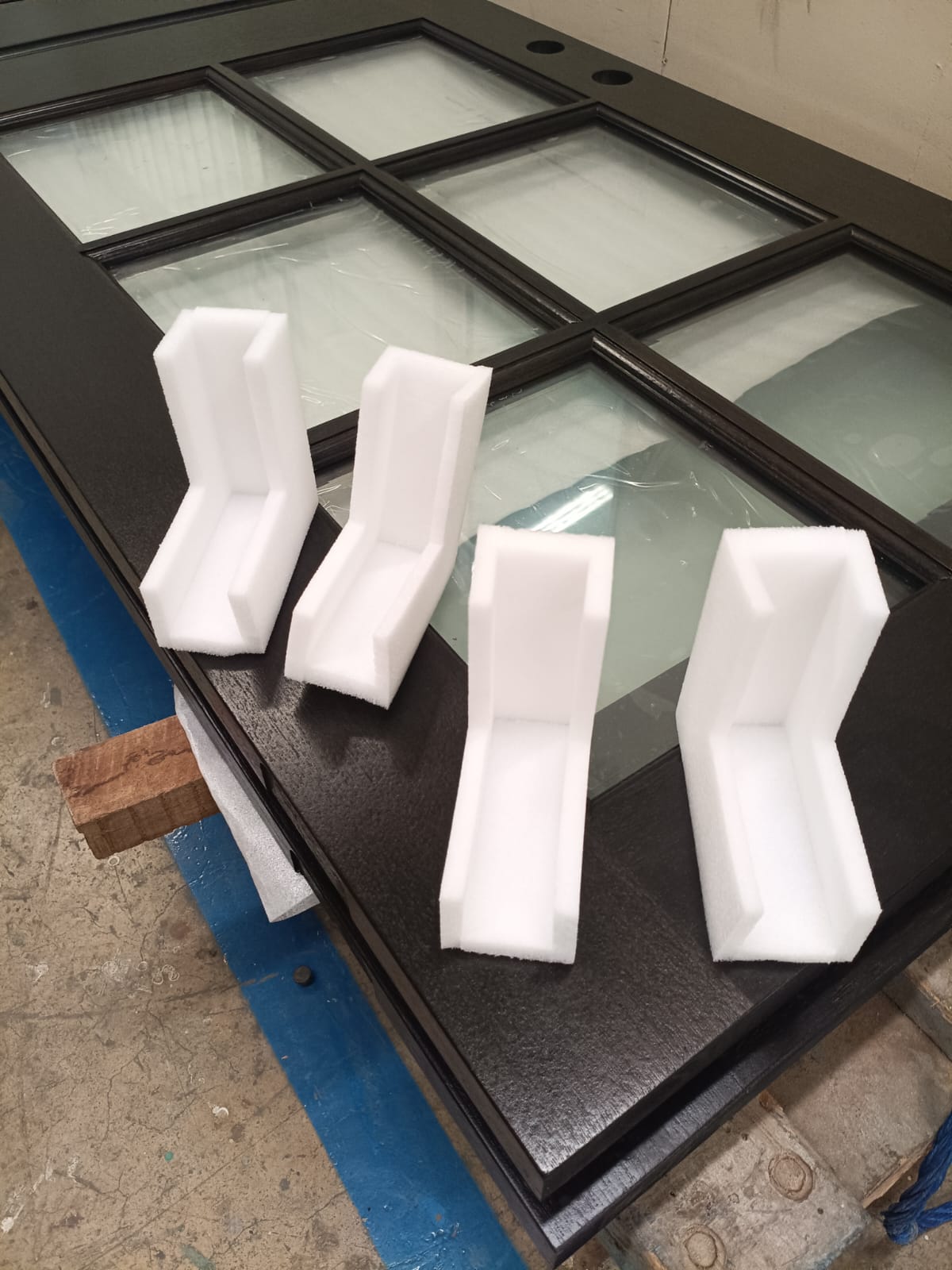
EPE Foam Corner for Door and Window Packaging — Indonesia Project
This Mailong Packaging project used custom EPE foam corners designed for finished doors and windows. The specified dimensions and density supported a repeatable packaging operation for a production-scale order.
- Finished dimensions: 150 × 150 × 65 mm
- Foam density: 64 kg/m³
- Production quantity: 30,000 pieces
- Application: Cushioning vulnerable product corners
- Packaging objective: Protective fit and a consistent finished appearance
The lesson is not that every door or window requires the same 64 kg/m³ foam or the same profile. The lesson is that a repeatable specification helps a factory standardize its packaging operation. For your product, the correct dimensions, density, fit, and protective performance should be confirmed through a sample and application review.
Buying Considerations: How to Evaluate Foam Corner Protectors
Before placing a bulk order, we recommend reviewing the following points with the supplier. These questions are more useful than asking only for a price per piece.
1. Confirm the exact dimensions
Provide the product’s corner geometry, edge thickness, and any surface or finish that must not be scratched. If the protector wraps around two or three sides, specify the dimensions of each side and the intended fit. A drawing or physical sample is preferable to a description such as “fits a standard frame.”
2. Specify material and density
Ask the supplier to identify the foam material and provide the density or grade where relevant. Density alone does not determine cushioning performance, but it helps establish a repeatable material specification. The final design should also consider thickness, geometry, compression response, and the product’s load.
3. Request a sample before mass production
Check that the protector fits securely without forcing it onto the product or leaving excessive movement. Inspect whether the foam contacts finished surfaces, whether the corners remain protected after packing, and whether operators can apply it consistently.
4. Test the complete package
A corner protector is only one component of the shipping system. Test it with the actual carton, wrapping, product orientation, and expected load. Where appropriate, use a packaging validation plan that reflects the hazards of your distribution route, including impact, vibration, and compression.
5. Compare total cost rather than unit price
Include freight, storage volume, packing labor, scrap, damage rates, and replacement shipments. A custom protector with a higher unit price may still be economical if it reduces product damage or speeds up packing. Conversely, custom tooling may not be justified for a low-volume product that fits a standard protector adequately.
Common Mistakes When Sourcing Foam Corner Protectors
- Choosing by appearance alone. Similar-looking foam profiles can have different material properties and dimensions.
- Assuming higher density always means better protection. Cushioning depends on the complete design and the impact conditions.
- Ignoring product surface requirements. A corner protector may prevent dents but still allow scratches if the product can move or rub against another surface.
- Ordering bulk quantities without a fit check. A small dimensional mismatch becomes costly when multiplied across thousands of pieces.
- Overlooking packing labor. A protector that is difficult to apply can slow the line and increase inconsistent packing.
- Comparing quotes with different specifications. Material, density, dimensions, tolerances, and packaging quantity must match for a meaningful comparison.
- Failing to define quality acceptance criteria. Agree on dimensions, material, appearance, and allowable variation before production.
Why Consider Mailong Packaging for Foam Corner Protection?
Mailong Packaging supplies protective packaging materials, including EPE and EVA foam products, for applications where goods need cushioning during handling and transport. For buyers evaluating foam corner protectors, the most useful conversation is about the product being shipped, the damage risk, the packaging workflow, and the required production specification.
For a custom project, provide the dimensions of the product, the vulnerable corners, the expected shipping conditions, the order quantity, and any constraints on packaging appearance or storage. This information helps establish whether a standard profile is sufficient or whether a custom EPE foam corner should be considered.
Mailong’s range also includes EPE foam, EVA foam, and other protective packaging products. If corner protection is only one part of your packaging requirement, a combined solution may be more practical than sourcing each component separately.
For buyers comparing materials and sourcing channels, explore the guide to packing foam sheets wholesale suppliers and the overview of packaging foam rolls wholesale suppliers.
Expert Recommendation: Which Place Should You Choose?
For standard corner protectors and occasional shipments, start with a packaging supply company or marketplace. You can compare common sizes, buy a small quantity, and verify whether the fit is adequate without committing to a custom order.
For regular shipments, large quantities, or products with costly damage risks, we recommend contacting a foam manufacturer or specialist protective packaging provider. Ask for a sample, a clearly defined specification, and a quote based on the same dimensions and material across suppliers.
For doors, windows, furniture, and other products with exposed edges, custom EPE foam corner protectors can be a worthwhile investment when the design is validated and the production specification is repeatable. The right solution is not necessarily the most complex one. It is the one that protects the product reliably while keeping packing labor, material usage, and total shipping cost under control.
Frequently Asked Questions
1. Where can I buy foam corner protectors for shipping?
You can buy foam corner protectors from packaging supply companies, online marketplaces, foam manufacturers, industrial distributors, and specialist protective packaging providers. Choose based on order quantity, required dimensions, material specification, and whether you need custom design support.
2. What are foam corner protectors used for?
Foam corner protectors cushion vulnerable corners and edges during shipping, handling, and storage. They are commonly used for doors, windows, furniture, appliances, frames, and other products that may be damaged by impact or contact at their edges.
3. Is EPE foam good for shipping corner protection?
EPE foam is a common option for shipping corner protection because it is lightweight and can be fabricated into sheets, rolls, and custom profiles. The correct density, thickness, geometry, and fit depend on the product’s weight and shipping conditions.
4. Should I buy standard or custom foam corner protectors?
Standard protectors are usually more convenient for small orders and products with common dimensions. Custom foam corner protectors are worth considering for recurring shipments, unusual shapes, or products where a secure fit and repeatable packaging process are important.
5. Does higher-density foam provide better corner protection?
Not automatically. Density is one material specification, but cushioning performance also depends on foam thickness, geometry, compression behavior, impact energy, and the product’s load. Select the protector based on the complete application and validate it with a sample or packaging test.
6. How do I choose the right size of foam corner protector?
Measure the product’s corner dimensions and the thickness of the edges that the protector must cover. Check the inside dimensions and profile of the foam protector, then test whether it fits securely without damaging the surface or leaving excessive movement.
7. Are foam corner protectors enough to protect fragile products?
They may be sufficient for some products, but they do not replace a complete packaging design. Fragile items may also need surface protection, foam sheets, inserts, blocking, a suitable carton, and a validated packing arrangement.
8. What information should I send a foam manufacturer for a quotation?
Provide product dimensions, corner geometry, material preference if known, required density or grade, order quantity, shipping conditions, packaging method, and any drawing or sample. Also ask about minimum order quantity, lead time, dimensional tolerances, sampling, and quality-control criteria.
References
- ASTM International — standards organization with technical standards relevant to materials, testing, and packaging performance. Consult the applicable standard for the specific test required.
- International Safe Transit Association (ISTA) — resources and test protocols for evaluating packaged-product performance during distribution.
- USDA Forest Products Laboratory, Wood Handbook: Wood as an Engineering Material — technical reference on wood properties and material behavior relevant to products such as doors, frames, and other wood-based goods that may require protective packaging.
Packaging performance depends on the product, foam specification, packaging configuration, and distribution hazards. References are starting points for technical evaluation; they do not certify a particular foam corner protector or package design.