Choosing between a corrugated box and a bubble mailer is not simply a question of which package costs less. The right choice depends on what you are shipping, how easily it can be damaged, the parcel’s dimensions and weight, and how much protection your customer expects. A bubble mailer can be an efficient solution for compact, lightweight products. A corrugated box is usually the better choice when an item is fragile, rigid, bulky, heavy, or vulnerable to crushing.
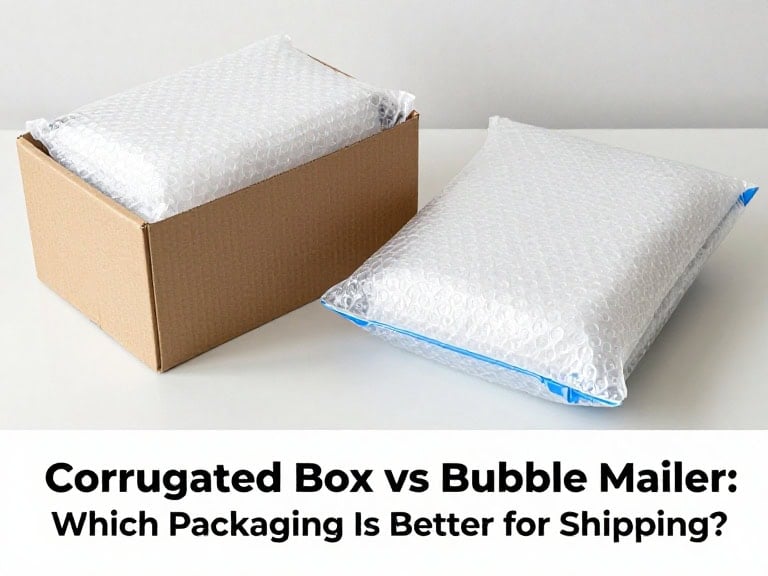
For e-commerce sellers and commercial shipping teams, the wrong packaging decision creates costs that are easy to overlook: damaged products, replacement shipments, customer complaints, and unnecessary dimensional weight. From our experience in protective packaging, the best approach is to match the packaging structure to the product’s actual shipping risks instead of choosing one format for every order.
Quick Answer: Corrugated Box vs Bubble Mailer
Choose a corrugated box when shipping fragile, heavy, rigid, irregularly shaped, or high-value products that need structural protection and space for cushioning. Choose a bubble mailer for lightweight, compact, relatively durable products that mainly need surface protection and limited impact cushioning.
For most professional situations, a bubble mailer is worth using when it can safely contain the product without excessive movement or compression risk. A corrugated box is worth the additional packaging and shipping cost when the product needs a protective outer structure. If the product is both fragile and compact, consider a bubble mailer only as an outer format when its cushioning is genuinely sufficient; otherwise, use a small corrugated box with suitable internal protection.
1. What Are Corrugated Boxes and Bubble Mailers?
What is a corrugated box?
A corrugated box is a protective shipping container made from corrugated fiberboard. Its structure typically consists of a fluted paper layer between flat linerboards. The fluted medium creates a lightweight but relatively rigid structure that helps the box resist compression, distribute impacts, and protect the contents during handling and transportation.
Corrugated packaging is available in different board constructions and strengths. Single-wall boxes are suitable for many everyday shipping applications, while double-wall and heavier-duty constructions can provide additional strength for heavier products, stacking, or more demanding distribution conditions. The correct specification depends on product weight, dimensions, shipping distance, stacking exposure, and the required level of protection.
For businesses shipping automotive components, appliances, industrial parts, or multiple products in one parcel, a properly specified corrugated box offers a practical combination of structural support, customization, and cushioning space.
What is a bubble mailer?
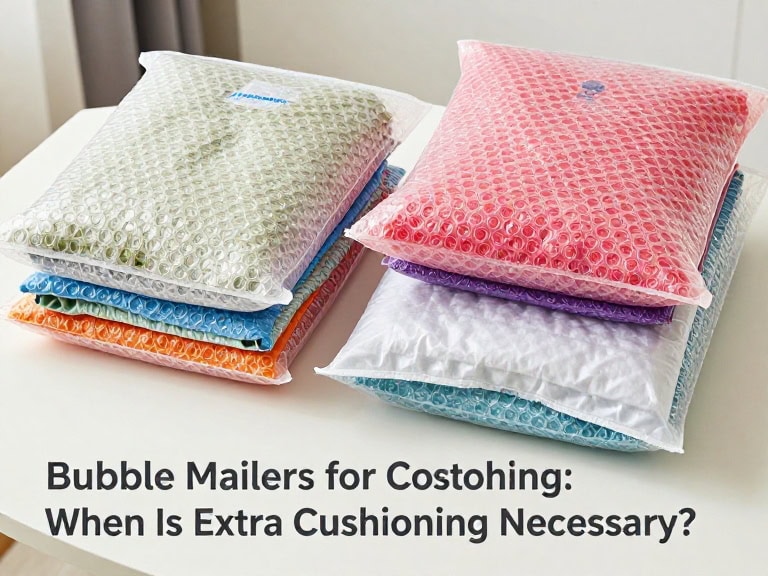
A bubble mailer is a flexible mailing envelope with a protective bubble-lined interior. The outer layer may be made from paper or plastic film, while the inner bubble material provides cushioning against minor impacts and abrasion. Most bubble mailers include a self-sealing adhesive closure for convenient packing.
Bubble mailers are popular in e-commerce because they are lightweight, compact, and quick to pack. They work particularly well for items that are relatively durable but could be scratched, scuffed, or affected by light handling impacts.
However, bubble cushioning should not be confused with structural protection. A bubble mailer does not provide the same resistance to crushing or bending as a corrugated box. If a parcel is squeezed under heavier packages, the flexible envelope may transfer pressure to the product inside.
Mailong Packaging supplies bubble mailers and other protective packaging formats for commercial shipping applications.
2. How Corrugated Boxes and Bubble Mailers Protect Products
The main difference between these two formats is how they manage shipping forces. A corrugated box provides a protective structure around the product. A bubble mailer provides flexible cushioning and surface protection, but much less resistance to external compression.
How corrugated boxes work
The fluted paper structure helps absorb and distribute impact energy. The box also creates a physical separation between the product and external handling forces. When correctly sized and combined with suitable internal packaging, it can reduce movement, protect corners, and prevent direct contact with other parcels.
For effective protection, the product should not move freely inside the box. Empty space should be managed with suitable cushioning, inserts, paper, foam, or other protective materials. A strong box with poor internal packing can still allow a product to break during transit.
How bubble mailers work
The air-filled bubbles inside a mailer provide a cushioning layer between the product and the outer envelope. This layer helps reduce minor impacts and friction. The flexible construction also allows the mailer to conform more closely to compact products, reducing unnecessary package volume.
Bubble mailers are not designed to replace a rigid protective structure. They offer limited protection against concentrated pressure, heavy stacking, sharp objects, or severe drops. Their performance depends on bubble size, film strength, seal quality, and the characteristics of the product being shipped.
Practical distinction: A bubble mailer is primarily a cushioning envelope. A corrugated box is a structural shipping container. If your product needs both cushioning and crush resistance, use a corrugated box with an appropriate internal protective material rather than expecting one layer of bubble material to do everything.
3. Corrugated Box vs Bubble Mailer: Key Differences
The comparison below reflects typical commercial packaging applications. Actual performance depends on material grade, dimensions, construction, product weight, packing method, and shipping conditions.
| Comparison factor | Corrugated box | Bubble mailer |
|---|---|---|
| Basic structure | Rigid or semi-rigid corrugated fiberboard container | Flexible envelope with internal bubble cushioning |
| Crush resistance | Generally better when the correct board strength is selected | Limited; flexible construction can transfer pressure to contents |
| Impact protection | Good when combined with correctly designed internal cushioning | Suitable for minor impacts and light handling shocks |
| Surface protection | Depends on internal packing and product restraint | Good for reducing scratches and surface abrasion |
| Weight | Usually heavier than a comparable bubble mailer | Usually lighter |
| Package volume | Can be larger because of clearance and cushioning requirements | Compact and flexible for small, flat products |
| Best product types | Fragile, rigid, bulky, heavy, or multi-item products | Lightweight, compact, relatively durable products |
| Internal protection space | Allows foam, inserts, dividers, and other cushioning | Limited space for additional protective structures |
| Stacking and warehouse handling | Better suited to stacking when properly specified | Not intended to provide substantial stacking support |
| Customization | Can be customized by dimensions, board construction, printing, and inserts | Can be customized by size, material, thickness, and printing |
| Typical commercial advantage | Protection and presentation for products needing a rigid package | Lower package weight and faster packing for suitable products |
There is no universal winner. If the product is a T-shirt, a small accessory, or a durable flat item, a bubble mailer may be the more efficient choice. If it is a glass component, a small appliance, a mechanical part with protruding edges, or a multi-item order, a corrugated box is generally the safer starting point.
4. Best Use Cases: When Should You Choose Each Packaging Type?
When a corrugated box is the better choice
- Fragile products: Glassware, ceramics, electronic devices, and delicate components that need structural protection and internal cushioning.
- Heavy products: Metal parts, tools, automotive components, and products that could deform a flexible envelope.
- Irregularly shaped products: Items with sharp edges, protrusions, or unusual dimensions that need a stable outer container.
- Multi-item orders: Bundles that require dividers, inserts, or separation between products.
- Products exposed to stacking: Shipments likely to be stored or transported under other parcels.
- Retail-ready or branded packaging: Products that need a more structured presentation and printed packaging.
For automotive parts and other industrial products, a box should be selected according to the product’s weight, shape, and handling conditions. A purpose-designed high-strength corrugated shipping box for automotive spare parts is a more appropriate starting point than a flexible mailer when the shipment needs structural support.
When a bubble mailer is the better choice
- Clothing and fabric accessories: T-shirts, scarves, and other soft goods that do not need rigid protection.
- Small lightweight accessories: Durable products that need protection from scratches and minor impacts.
- Trading cards and flat collectibles: Suitable mailers can provide cushioning, although rigid inserts may still be needed to prevent bending.
- Printed materials: Certain documents, booklets, and flat items that are not easily crushed or damaged by bending.
- Compact e-commerce orders: Products that fit securely without excessive pressure or movement.
For products such as trading cards, choose a mailer with appropriate dimensions and add a rigid backing or protective sleeve when bending is a concern. A purpose-specific bubble mailer for trading cards can help protect the product surface, but it should not be treated as a substitute for a rigid card protector.
When neither option is enough on its own
Some products need a combination of packaging materials. Fragile ornaments, sensitive electronics, and products with delicate corners may require foam, molded inserts, air cushions, or a dedicated protective pouch inside a corrugated box.
For delicate decorative products, consider a dedicated bubble wrap pouch or another fitted cushioning layer. The outer box then provides structural protection while the inner material helps control movement and absorb impact.
5. Pros and Cons of Corrugated Boxes vs Bubble Mailers
Both packaging types can reduce shipping costs when used correctly. Their weaknesses become expensive when the product is not suited to the format.
| Packaging type | Pros | Cons | Our assessment |
|---|---|---|---|
| Corrugated box | Structural support; better crush resistance; accommodates inserts and dividers; suitable for heavier and fragile goods; customizable dimensions and printing | Usually heavier; can increase parcel dimensions; requires more packing materials and assembly time | Best when product protection and shipping reliability matter more than minimizing package weight |
| Bubble mailer | Lightweight; compact; quick to pack; provides surface protection and minor impact cushioning; suitable for many small e-commerce orders | Limited crush resistance; less suitable for heavy or fragile products; limited internal packing space; may not prevent bending | Best for durable, compact products where a rigid container would add unnecessary cost |
Our view is straightforward: do not use a bubble mailer just because it is cheaper to purchase. If it causes even a small increase in damage and replacement shipments, the apparent saving can disappear quickly. Likewise, do not put every lightweight product into a box. That adds material, packing labor, and potentially shipping expense without necessarily improving protection.
6. Which Is Cheaper to Ship: A Corrugated Box or Bubble Mailer?
In many cases, a bubble mailer costs less to purchase and weighs less than a corrugated box. It can also reduce the time required to pack an order. However, the cheapest packaging material does not always produce the lowest total shipping cost.
Carriers commonly calculate parcel charges using some combination of actual weight, dimensional weight, package dimensions, service type, and destination. The exact rules vary by carrier, service, and market. A large, lightweight box can be charged based on dimensional weight, while a compact mailer may remain in a lower pricing category. You should check the current carrier rules for your shipping lane rather than assume that one format always costs less.
Compare total landed packaging cost
For a meaningful cost comparison, include more than the unit price of the packaging. Calculate:
- Packaging purchase price per shipment
- Additional cushioning or inserts
- Packing labor and assembly time
- Shipping charges based on actual and dimensional weight
- Storage space and packaging inventory costs
- Expected damage, return, and replacement costs
Example: a small durable accessory versus a fragile component
Imagine an online store shipping a lightweight phone accessory. If the product fits securely in a bubble mailer and does not need rigid protection, a box may add weight and volume without meaningful benefit. The mailer is likely to be the more economical option.
Now consider a metal component with sharp edges or a fragile electronic part. A bubble mailer may be cheaper per unit, but it may not prevent crushing, bending, or damage from concentrated impact. A corrugated box with suitable internal protection may cost more initially but reduce the expected cost of damage claims and replacement shipments.
For a deeper shipping-cost comparison, see our guide to whether it is cheaper to ship a box or a bubble mailer.
Commercial recommendation: Compare packaging options using cost per successfully delivered order, not cost per empty package. A package that saves a few cents but increases damage, returns, or customer-service work is not a cost-saving solution.
7. Shipping Risks That Should Determine Your Packaging Choice
Before selecting corrugated boxes or bubble mailers, identify the risks your product will face between the packing station and the customer’s door.
Crushing and stacking pressure
Parcels may be stacked in warehouses, delivery vehicles, and distribution centers. A corrugated box provides a structure that can resist compression when the board grade, dimensions, and construction are appropriate. A bubble mailer offers very limited protection from heavy pressure.
Impact and dropping
Packages can be dropped, bumped, or handled roughly. A corrugated box can create a protective space around the product, but it needs correctly designed internal cushioning. A bubble mailer can reduce minor impact and abrasion, but it may not absorb enough energy to protect fragile products from a severe drop.
Moisture and contamination
Neither ordinary corrugated board nor a standard bubble mailer should automatically be treated as waterproof. Corrugated board can weaken when exposed to moisture. Plastic bubble mailers may provide better resistance to light surface moisture, depending on construction and closure, but seams and openings remain potential entry points.
If moisture exposure is a major concern, evaluate the complete packaging system. This may include a sealed inner bag, moisture-resistant materials, or an appropriate outer protective layer.
Sharp edges and puncture risks
Products with exposed metal edges, screws, corners, or pointed parts can puncture flexible mailers. A corrugated box with proper internal restraint is usually the safer option. For particularly sharp or heavy items, reinforce the packing design rather than relying on a standard carton alone.
Product movement inside the package
Internal movement is a frequent cause of damage. A product that slides around inside a box can hit the walls repeatedly. A mailer that is too large may allow the product to shift and concentrate impact on one edge. Select the package size carefully and use inserts or cushioning when needed.
8. Common Mistakes When Choosing Between Corrugated Boxes and Bubble Mailers
Mistake 1: Choosing packaging based only on product weight
A lightweight product can still be fragile. Glass, ceramics, thin electronic components, and delicate plastic parts may need a box even when they weigh very little. Product fragility and geometry matter as much as weight.
Mistake 2: Assuming bubble mailers prevent bending
Bubble cushioning helps reduce minor impacts and scratches, but it does not create a rigid protective shell. Flat products such as cards, photographs, or thin accessories may need a rigid backing board or a box to prevent bending.
Mistake 3: Buying oversized corrugated boxes
A box that is too large requires more cushioning and can allow the product to move during shipping. It may also increase dimensional weight. Choose a box that provides enough clearance for protective materials without unnecessary empty space.
Mistake 4: Ignoring the product’s sharp edges
Sharp corners can puncture a flexible mailer and damage the product or other parcels. Use a rigid box or add suitable edge protection when the product’s geometry creates a puncture risk.
Mistake 5: Using the same packaging for every order
Many e-commerce businesses ship products with different dimensions, weights, and fragility levels. A single packaging format is rarely the most efficient choice across an entire catalog. Create packaging rules by product category or SKU.
Mistake 6: Skipping real-world shipping tests
A package that looks adequate on a packing table may fail during distribution. Test representative packed products under relevant handling conditions. Use recognized test methods where appropriate and assess the package after testing, not just the outer material before use.
9. What to Consider When Buying Corrugated Boxes or Bubble Mailers
Buying decisions should start with the product and the distribution environment. Once those requirements are clear, compare material specifications and supplier capabilities.
Buying corrugated boxes
- Board construction: Select single-wall, double-wall, or another suitable construction according to product weight and shipping conditions.
- Box dimensions: Measure the product and allow enough space for internal cushioning without creating excessive empty volume.
- Board strength: Evaluate the appropriate performance specification for stacking, handling, and distribution requirements.
- Internal protection: Decide whether the product needs dividers, foam inserts, paper cushioning, or other protective materials.
- Printing and branding: Consider whether branded printing or clear handling information adds value to the customer experience.
- Order volume: Compare unit price, storage requirements, minimum order quantity, and the cost of holding packaging inventory.
For businesses sourcing multiple carton formats, explore the corrugated box and rigid box range and define specifications around actual product requirements.
Buying bubble mailers
- Mailer dimensions: Confirm the usable internal dimensions rather than relying only on external measurements.
- Bubble cushioning: Check the bubble structure and thickness against the product’s surface and impact-protection needs.
- Outer material: Compare paper and plastic constructions based on durability, moisture exposure, appearance, and shipping requirements.
- Closure quality: Check adhesive performance and whether the seal remains secure during handling.
- Product compatibility: Make sure the item fits without forcing the envelope or placing pressure on fragile edges.
- Customization: Review printing, size options, and consistent supply for repeat orders.
If you are comparing sourcing options for commercial quantities, our guide to bubble mailer suppliers for commercial packaging can help frame the purchasing questions.
Should you use a combination of packaging materials?
For fragile or irregular products, a combination is often the better solution. A corrugated box can provide the outer structure, while bubble wrap, foam, or a fitted pouch controls movement and reduces direct impact. For products needing surface protection inside a carton, corrugated cardboard rolls may also be useful as a wrapping or separation material, depending on the application.
10. Choosing a Packaging Manufacturer: What Commercial Buyers Should Check
A reliable packaging manufacturer should do more than quote a price per box or mailer. It should understand the product, the shipping conditions, and the packaging performance required. This matters especially when packaging is purchased repeatedly or used across several product categories.
Evaluate product range and manufacturing experience
A supplier with experience in both corrugated packaging and protective cushioning can help you compare complete packaging solutions instead of recommending only the product it happens to sell. Ask whether the manufacturer can support custom sizes, material specifications, repeat orders, and packaging changes as your product range develops.
Check quality consistency
For corrugated boxes, ask about board construction, dimensions, print consistency, and the quality checks used during production. For bubble mailers, review material consistency, seal performance, bubble integrity, and dimensional accuracy. Samples should be evaluated using the actual product whenever possible.
Understand customization and minimum order quantities
Custom packaging may improve fit and reduce waste, but it can require tooling, setup, or larger order quantities. For a new product, start with a practical sample or trial order where available. For established products with stable demand, custom dimensions can improve packing efficiency and reduce unnecessary shipping volume.
Compare total supply cost
Commercial buyers should include unit price, shipping to the packing facility, storage, lead time, minimum order quantity, defect handling, and replenishment reliability. A slightly higher unit price may be justified if it comes with better consistency and fewer packing problems.
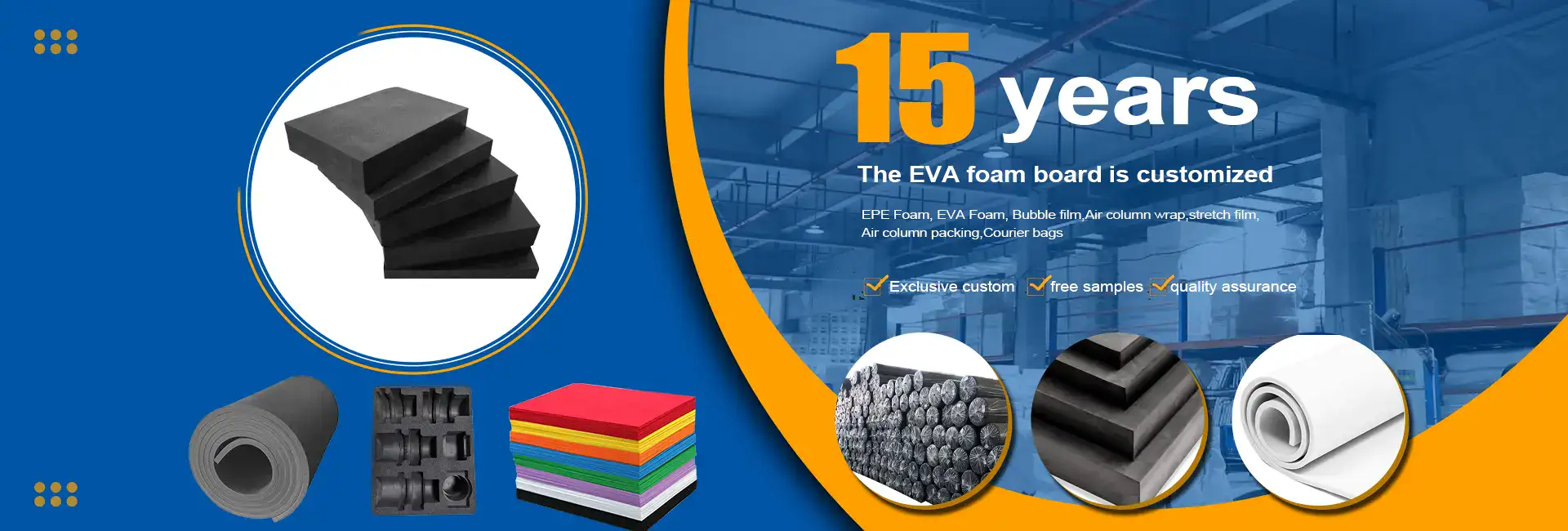
Mailong Packaging: Protective Packaging Manufacturer Since 2009
Mailong Packaging Co., Ltd. was established in 2009 and manufactures and exports a range of packaging materials, including corrugated boxes, bubble mailers, inflatable bubble and pillow film, air column rolls, air column bags, EPE and EVA foam, poly mailers, stretch wrap, and BOPP tape.
Its protective packaging products are designed to help reduce collision damage, abrasion, and static-related risks during logistics transportation. Mailong Packaging serves overseas markets in more than 30 countries.
For buyers comparing packaging formats, the practical advantage is being able to evaluate different protective materials according to the product and shipping application. View the Mailong Packaging e-catalog to explore available packaging solutions.
11. Our Expert Recommendation: Which Packaging Should You Choose?
We recommend making the decision by product risk, not by packaging preference. A bubble mailer is not automatically the economical option, and a corrugated box is not automatically the safer option unless it is correctly sized and packed.
For lightweight e-commerce products
Use bubble mailers for soft goods, compact accessories, and durable items that do not need rigid protection. They can reduce packaging weight, storage space, and packing time. Make sure the item cannot puncture the envelope or bend under normal parcel handling.
For fragile and high-value products
Choose a corrugated box with suitable internal cushioning. Do not rely on the carton alone. The product should be restrained and protected from direct contact with the box walls. For expensive or delicate products, test the complete packed configuration before using it at scale.
For heavy-duty and industrial applications
Use a corrugated box designed around the product’s weight, shape, and stacking conditions. Add inserts or protective materials where necessary. For automotive parts, machinery components, and dense products, a flexible bubble mailer is generally not an appropriate primary shipping container.
For businesses shipping a mixed product catalog
Build a packaging matrix rather than forcing every SKU into one format. Group products by weight, fragility, dimensions, puncture risk, and value. Define a preferred package for each group, then review damage rates and shipping costs periodically.
Our final verdict: Corrugated boxes are the better choice when structural protection is essential. Bubble mailers are the better choice when the product is lightweight, compact, and durable enough to ship without a rigid outer container. If you are uncertain, test both formats with the actual product and compare the total cost per undamaged delivery. That is a more reliable buying decision than comparing packaging prices alone.
12. Quick Summary: Corrugated Box vs Bubble Mailer
| Decision factor | Choose corrugated box when… | Choose bubble mailer when… |
|---|---|---|
| Product fragility | The product can break, bend, or deform under pressure | The product is relatively durable |
| Product weight | The item is heavy or dense | The item is lightweight |
| Product shape | The item is irregular, rigid, or has sharp edges | The item is compact, flat, or flexible |
| Protection requirement | Crush resistance and internal cushioning are needed | Surface protection and minor impact cushioning are sufficient |
| Shipping cost | Protection justifies the additional package weight or volume | Lower package weight and compact dimensions are priorities |
| Best commercial fit | Electronics, automotive parts, appliances, fragile goods, and multi-item orders | Clothing, small accessories, trading cards with suitable inserts, and durable flat goods |
| Our recommendation | Use when product protection is the priority | Use when the product does not need rigid structural protection |
13. Frequently Asked Questions
1. Is a corrugated box better than a bubble mailer?
A corrugated box is generally better for fragile, heavy, irregularly shaped, or crush-sensitive products because it provides structural protection. A bubble mailer is better for lightweight, compact, relatively durable products that mainly need surface protection and minor impact cushioning. The best choice depends on the product and shipping conditions.
2. Are bubble mailers safe for fragile items?
Bubble mailers can protect some small and moderately delicate products from scratches and minor impacts, but they provide limited crush resistance. For glass, ceramics, delicate electronics, and other fragile products, a corrugated box with suitable internal cushioning is usually the safer option.
3. Are bubble mailers cheaper to ship than boxes?
Bubble mailers are often lighter and more compact, which can reduce shipping costs for suitable products. However, carrier pricing depends on actual weight, dimensional weight, dimensions, service, and destination. The total cost should also include damage, returns, and replacement shipments.
4. Can I ship electronics in a bubble mailer?
It depends on the electronic product. Durable, compact accessories may be suitable when properly protected. Devices with screens, circuit boards, fragile connectors, or sensitive components generally need a rigid box and appropriate cushioning. Anti-static protection may also be necessary for electronic components.
5. Do corrugated boxes provide better crush protection?
Generally, yes. Corrugated boxes provide a structural container that can resist stacking and compression forces when the board construction and box design are suitable. Actual performance depends on board strength, box dimensions, humidity, packing quality, and handling conditions.
6. Can bubble mailers prevent products from bending?
Not reliably. Bubble cushioning helps protect against minor impacts and abrasion, but it does not provide the rigidity needed to prevent many flat products from bending. Use a rigid insert, backing board, or corrugated packaging when bending is a concern.
7. Which packaging is better for e-commerce businesses?
Both can be useful. Bubble mailers are efficient for lightweight products that do not need rigid protection. Corrugated boxes are more suitable for fragile, heavy, bulky, or multi-item orders. Many e-commerce businesses benefit from using both formats according to SKU-level packaging rules.
8. Can corrugated boxes and bubble mailers be used together?
Yes. A bubble mailer or bubble pouch can protect a product’s surface inside a corrugated box, while the box provides structural protection. The combination can be useful for fragile products, but the internal material should be selected and tested for the actual product.
9. What should I check before buying corrugated boxes in bulk?
Check board construction, dimensions, strength requirements, printing, internal packaging needs, minimum order quantity, sample quality, lead time, and total delivered cost. Test the complete package with the product before committing to a large production quantity.
10. How do I choose the right bubble mailer size?
Measure the product and compare it with the mailer’s usable internal dimensions. Allow enough space for easy insertion without excessive movement. Avoid forcing the product into the mailer, stretching the seams, or placing pressure on fragile edges.
14. References and Packaging Standards
For commercial packaging decisions, use recognized test methods and validate the complete packed product. The following organizations provide relevant standards and technical resources:
- ASTM International – Standards and test methods relevant to packaging materials, corrugated fiberboard, and distribution testing.
- International Safe Transit Association (ISTA) – Transport packaging test procedures and guidance for evaluating packaged-product performance during distribution.
- Fibre Box Association – Technical resources and industry information about corrugated packaging and box performance.
Packaging performance depends on the complete package design, product characteristics, and distribution environment. Confirm the applicable test procedure and current carrier requirements before finalizing a commercial packaging specification.