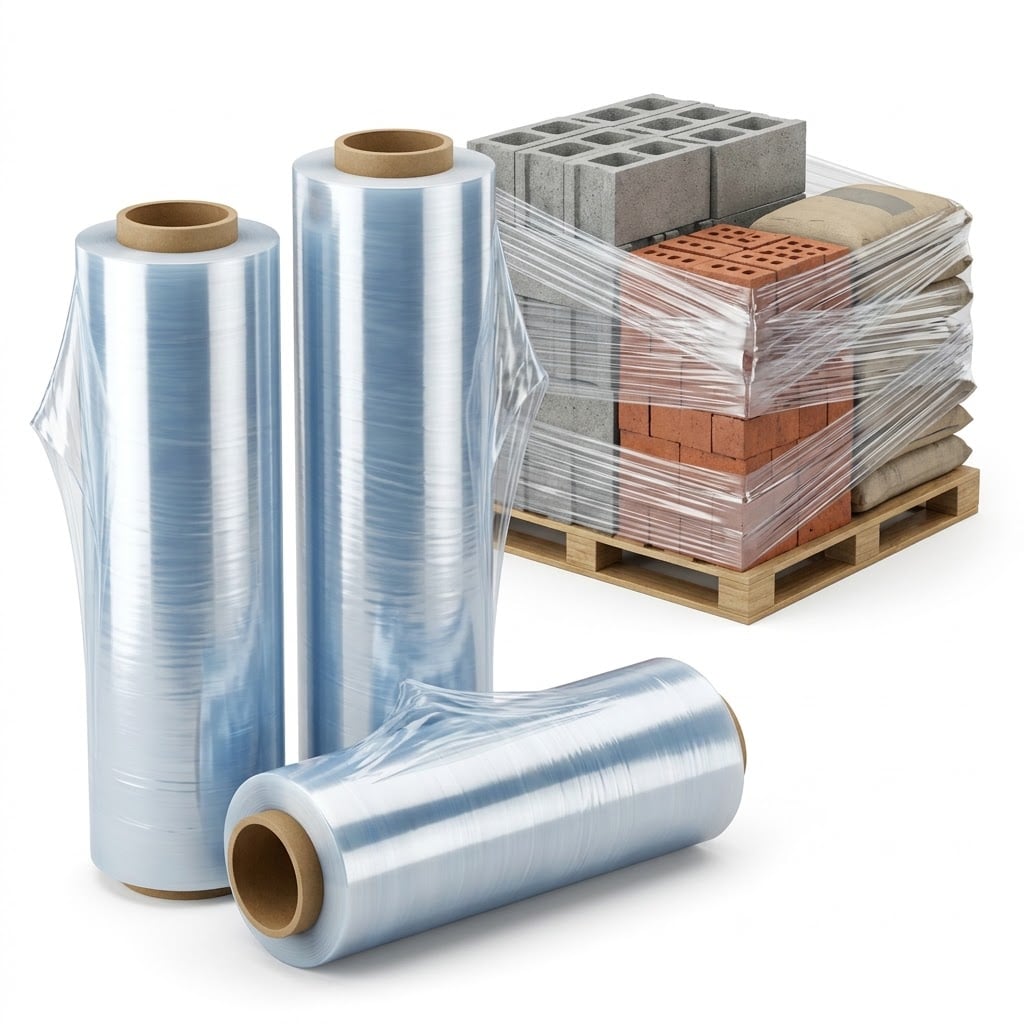

Reliable Stretch Film for Building Materials Logistics
For construction material manufacturers, wholesalers, distributors, and logistics providers, maintaining load stability throughout the supply chain is essential. Our pallet stretch film helps hold products together, reduce load shifting, and provide an additional layer against dust, surface abrasion, and routine handling exposure.
Mailong Packaging has supplied packaging materials to overseas markets in more than 30 countries since its establishment in 2009. We offer packaging solutions for different industries, with product specifications available for confirmation according to your load dimensions, wrapping equipment, and transportation requirements.
Quick Answer: Which Stretch Film Is Suitable for Building Materials?
Stretch film made from LLDPE is a practical option for wrapping palletized building materials that need load containment during warehousing and transportation. For construction products with sharp corners, rough surfaces, or uneven profiles, puncture resistance, film thickness, stretch performance, and wrapping tension should all be considered.
Mailong Packaging offers construction pallet wrap with a specified thickness range of 17–30 μm. The appropriate thickness depends on the product’s weight, edge profile, pallet configuration, and wrapping method.
Product Specifications
| Parameter | Details |
|---|---|
| Product Category | Pallet Film |
| Application Scenario | Building Materials Logistics |
| Product Name | Stretch Film for Building Materials |
| Product Keyword | Construction Pallet Wrap |
| Material | LLDPE |
| Key Features | High puncture resistance |
| Size / Thickness | 17–30 μm |
| Industry | Construction Industry |
| Customer Concern | Load stability |
| Minimum Order Quantity (MOQ) | 10 rolls |
| HS Code | 3920109090 |
| Production Time | 3–7 days |
| Port | Shenzhen, China |
Specifications are based on the current product information provided. Please confirm roll width, roll length, net weight, core diameter, color, film performance, packaging details, and applicable customs classification before placing an order.
Why Choose Stretch Film for Building Materials?
1. High Puncture Resistance for Challenging Loads
Construction materials can have uneven surfaces, projecting corners, and rough edges that put extra stress on packaging film. This stretch film is specified with high puncture resistance to help withstand the demands of pallet wrapping.
The actual performance depends on film formulation, thickness, load geometry, and wrapping conditions. For materials with particularly sharp edges, consider using protective corner boards or cushioning underneath the stretch film.
2. Improved Pallet Load Stability
Palletized construction products may shift during forklift handling, loading, unloading, and transportation. Properly applied stretch film helps bind packages together and maintain a more unified load.
For heavy or tall pallets, film selection should be combined with a suitable wrapping pattern, adequate containment force, stable pallet loading, and other load-securing measures when required.
3. Flexible Thickness Options
The available thickness range is 17–30 μm, giving buyers options to evaluate according to load requirements and wrapping procedures.
-
17–20 μm: Consider for compatible loads where handling conditions and puncture risks are relatively moderate.
-
20–25 μm: Evaluate for general pallet wrapping when a balance of film consumption and load containment is needed.
-
25–30 μm: Consider for more demanding loads, including products with rougher profiles, subject to testing.
These ranges are preliminary selection guidelines rather than guaranteed performance categories. The best thickness should be confirmed through wrapping trials using the actual products and pallet configuration.
4. Practical Packaging for Warehousing and Transportation
Stretch film can help keep palletized products grouped during storage and distribution. When correctly applied, it can also reduce exposure to dust and minor surface abrasion.
Stretch film is not a substitute for waterproof packaging, rigid impact protection, or specialized anti-static materials. If building materials require protection against moisture, impact, or electrostatic discharge, additional packaging measures may be necessary.
5. Suitable for B2B Bulk Purchasing
With an MOQ of 10 rolls and a stated production lead time of 3–7 days, Mailong Packaging provides an option for businesses sourcing pallet film for recurring logistics and distribution needs.
Actual lead times depend on order specifications, production scheduling, quantity, and shipping arrangements. Buyers should confirm the final quotation and delivery schedule before ordering.
Applications of Construction Pallet Wrap
Stretch film can be considered for a variety of building material packaging applications, provided the load configuration and film specifications are suitable.
Bricks, Blocks, and Paving Products
Palletized bricks, concrete blocks, and paving products may have rough surfaces or angular edges. Stretch film can help consolidate the pallet load, while corner protectors and suitable pallet arrangements can reduce localized stress on the film.
Tiles and Flooring Materials
Cartons containing ceramic tiles, stone tiles, flooring panels, or similar products may need to remain grouped during warehouse handling. Stretch film can help secure the cartons to the pallet. Fragile products should also use appropriate inner cushioning and edge protection.
For additional cushioning, explore our EPE Foam Sheets and Bubble Cushioning Packaging options.
Pipes, Profiles, and Long Construction Components
Bundles of compatible pipes, profiles, and construction components may benefit from film wrapping to help keep grouped items together. For cylindrical or unusually shaped products, confirm that the selected wrapping method provides adequate containment and does not cause deformation.
Cement-Related Products and Bagged Materials
Bagged construction materials may be palletized for storage and transport. Stretch film can help stabilize the bags when used with suitable pallets and stacking practices. The packaging system should account for bag weight, pallet height, friction between layers, and the possibility of shifting.
Building Hardware and Accessory Cartons
Cartons containing fasteners, fittings, tools, or construction accessories can be wrapped together for easier handling. Where cartons have sharp edges or delicate printed surfaces, test the film and wrapping tension to reduce the risk of tearing or surface marks.
How to Choose the Right Stretch Film for Building Materials
Selecting construction pallet wrap involves more than choosing a thickness. Buyers should evaluate the complete pallet configuration and the conditions the load will encounter.
Step 1: Assess the Load Weight and Dimensions
Record the total pallet weight, pallet footprint, stack height, and shape of the products. Tall, heavy, or uneven loads may require a different wrapping pattern or additional restraint compared with compact, uniform cartons.
Step 2: Inspect Edges and Surface Conditions
Identify sharp corners, projecting components, rough surfaces, and other features that may puncture the film. Use edge protectors or secondary packaging when necessary instead of relying on film thickness alone.
Step 3: Select the Film Thickness
The specified range is 17–30 μm. A thicker film may be appropriate for demanding applications, but thickness alone does not determine overall performance. Film quality, stretch characteristics, puncture resistance, and application technique also matter.
Step 4: Confirm Manual or Machine Wrapping
Manual and machine wrapping can create different levels of tension and consistency. If you use an automatic or semi-automatic wrapping machine, confirm compatibility with the film’s roll dimensions, stretch behavior, and dispensing requirements.
Step 5: Test Load Containment
Before bulk deployment, wrap a representative pallet and evaluate load stability during normal handling. Check for film tearing, excessive stretching, loose layers, product movement, and damage to package edges.
Step 6: Confirm the Commercial Specifications
Before ordering, confirm roll width, length, weight, core size, thickness tolerance, packaging configuration, quantity, production lead time, shipping terms, and customs documentation requirements.
Stretch Film Thickness Comparison
| Thickness | Potential Use | Points to Evaluate |
|---|---|---|
| 17 μm | Compatible, relatively moderate-duty pallet loads | Edge sharpness, stretch performance, and required containment |
| 20 μm | General pallet wrapping trials | Load weight, pallet geometry, and film tension |
| 25 μm | More demanding wrapping applications | Puncture resistance, film consumption, and wrapping efficiency |
| 30 μm | Applications requiring evaluation of a thicker film | Sharp edges, heavy loads, and overall load-securing requirements |
This is a preliminary selection reference, not a certified load-capacity chart. Actual suitability must be validated under your operating conditions.
Stretch Film vs. Other Protective Packaging Materials
Different packaging materials serve different purposes. Stretch film primarily helps contain palletized loads, while cushioning and inflatable packaging materials are designed for other protection needs.
| Packaging Material | Primary Function | Typical Application |
|---|---|---|
| LLDPE Stretch Film | Pallet load containment and grouping | Construction materials and warehouse pallets |
| EPE Foam | Cushioning and surface protection | Delicate surfaces, gaps, and component separation |
| Inflatable Air Column Wrap | Cushioning around suitable individual products | Fragile items requiring additional impact cushioning |
| BOPP Packing Tape | Sealing compatible cartons | Closing shipping boxes and cartons |
| Poly Mailer Bags | Lightweight outer shipping packaging | Suitable apparel and non-fragile parcels |
Explore related Mailong Packaging products:
How to Order Stretch Film for Building Materials
Mailong Packaging works with B2B customers sourcing packaging materials for industrial, commercial, and logistics applications.
Step 1: Share your requirements. Provide your target film thickness, roll dimensions, estimated order quantity, and the type of construction materials being wrapped.
Step 2: Confirm product specifications. Review the proposed film details, packaging configuration, and any required performance criteria before approving the order.
Step 3: Confirm the quotation and lead time. The current listed MOQ is 10 rolls, with a stated production time of 3–7 days. Final timing depends on the confirmed order and production schedule.
Step 4: Arrange shipment. The listed port is Shenzhen, China. Confirm the shipping terms, destination, export documents, and freight arrangements with the supplier.
Step 5: Evaluate performance. Where load stability is critical, test the film with representative pallet loads before standardizing it across your operation.
Why Source from Mailong Packaging?
Established in 2009, Mailong Packaging manufactures and exports a range of packaging materials for customers in more than 30 countries.
Our product range includes inflatable bubble and pillow film, air column rolls, air column bags, EPE and EVA foam, poly mailers, stretch wrap, bubble mailers, BOPP tape, and corrugated boxes.
For customers handling construction products, industrial components, and e-commerce shipments, sourcing complementary packaging materials from one supplier can simplify product coordination and purchasing discussions. Product availability, customization options, specifications, and lead times should be confirmed for each order.
Company: Mailong Packaging
Address: Building A, Tiantou Hongjing Industrial Zone, Hengli Town, Dongguan City, Guangdong, China
Email: daveyang@mailongpak.com
Frequently Asked Questions
1. What material is used in stretch film for building materials?
The specified material is linear low-density polyethylene (LLDPE). The film is intended for pallet wrapping and load containment. Confirm the final material specification with the supplier before ordering.
2. What thicknesses are available?
The listed thickness range is 17–30 μm. The appropriate option depends on pallet weight, product edges, wrapping equipment, and the required level of load containment.
3. Is this stretch film suitable for heavy construction materials?
It may be suitable for compatible palletized construction materials, but suitability cannot be determined from thickness alone. Assess load weight, geometry, sharp edges, pallet quality, and wrapping conditions, and conduct practical load-stability tests.
4. Can stretch film prevent all transportation damage?
No. Stretch film helps contain palletized goods, but it cannot eliminate every transportation risk. Proper palletization, edge protection, cushioning, and suitable handling procedures may also be required.
5. Can I use this film with an automatic pallet wrapping machine?
Machine compatibility should be confirmed before ordering. Provide the machine type and required roll dimensions so that film specifications can be evaluated against your equipment.
6. What is the minimum order quantity?
The listed MOQ is 10 rolls. Confirm the final quantity, roll specifications, and any customization requirements with Mailong Packaging.
7. What is the production lead time?
The listed production time is 3–7 days. The actual schedule may vary according to order details, quantity, production capacity, and confirmation of specifications.
8. What HS code is listed for this product?
The supplied product information lists HS code 3920109090. Customs classification can depend on the product’s exact composition, structure, and applicable national tariff rules. Please verify the correct code with your customs broker or relevant authority before shipment.
9. What information should I provide to request a quotation?
Please provide your required thickness, roll width and length, roll weight, core diameter, order quantity, destination country, wrapping method, and the type and approximate weight of the building materials being palletized.
Request a Quote for Construction Pallet Wrap
Looking for stretch film for building materials logistics? Contact Mailong Packaging to discuss your film specifications, order quantity, and shipping requirements.
Email: daveyang@mailongpak.com
Share your pallet dimensions, product type, preferred thickness, and estimated monthly demand to help us evaluate a suitable packaging option for your business.