
Custom PU Foam Packaging Manufacturer | Mailong Packaging
Laboratory equipment often includes sensitive components, precision measurement systems, display panels, connectors, and accessories. A suitable foam insert helps keep these items in designated positions and supports a more consistent packaging arrangement. For instruments that require careful handling, the insert design should consider equipment weight, contact points, surface finishes, and the expected transportation environment.
Mailong Packaging supplies protective packaging materials for B2B customers worldwide. Established in 2009, we offer customized foam packaging solutions and a range of complementary materials for product protection during logistics transportation.
Contact Mailong Packaging at daveyang@mailongpak.com to discuss your requirements for custom PU foam for laboratory instruments.
Quick Answer: What Is PU Foam for Lab Instruments?
PU foam for lab instruments is flexible polyurethane foam used as cushioning or as a custom insert for packaging laboratory and measurement equipment. It can be configured to fit specific instrument shapes, provide separation between components, and help limit movement during normal handling and transportation.
Custom laboratory instrument foam is useful for packaging selected analytical instruments, measurement devices, testing equipment, and related accessories. The suitable foam properties and insert dimensions depend on the instrument’s sensitivity, weight, shape, and packaging conditions.
Important: Packaging foam can help support and cushion laboratory equipment, but it does not independently guarantee calibration retention, measurement accuracy, or protection against every impact. Sensitive instruments may require additional engineering controls and packaging validation.
Product Specifications
| Parameter | Details |
|---|---|
| Product Category | Flexible PU Foam |
| Application Scenario | Laboratory Equipment Packaging |
| Product Name | PU Foam for Lab Instruments |
| Primary Product Keyword | Laboratory Instrument Foam |
| Material | PU (Polyurethane) |
| Key Features | Precision Cushioning |
| Size/Thickness | Custom |
| Industry Use | Laboratory Equipment |
| Customer Concerns | Calibration Safety |
| Minimum Order Quantity (MOQ) | 100 pcs |
| HS Code | 3921139000 |
| Production Time | 7–15 Days |
| Port | Shenzhen |
Specifications are based on the information provided. Final foam properties, dimensions, processing details, and lead times should be confirmed before ordering. The HS code should be verified according to the final product and applicable customs requirements.
What Is Flexible PU Foam for Laboratory Instrument Packaging?
Flexible polyurethane foam is a cushioning material used in protective packaging and other applications. Its flexibility makes it suitable for packaging designs that need to accommodate different product contours and provide support around selected contact areas.
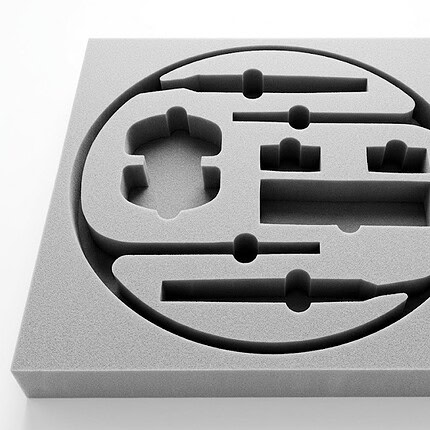
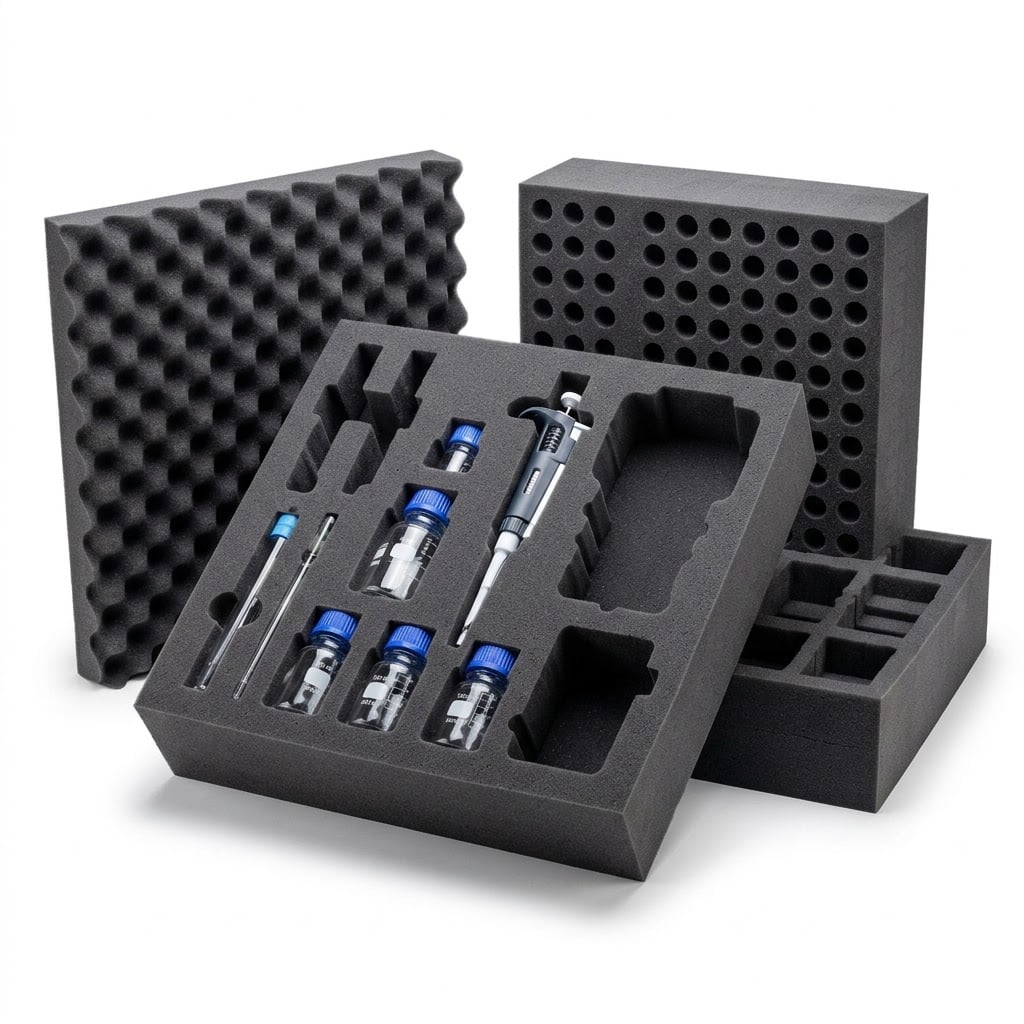
For laboratory equipment, foam packaging can be designed as a fitted insert or cushioning component inside a suitable box or case. The insert may include shaped cavities for the main instrument, detachable components, cables, probes, or other accessories, depending on the packaging layout.
A well-planned design aims to reduce unnecessary movement and prevent equipment from making direct contact with other items during routine handling. The final result depends on the foam formulation, density, firmness, thickness, cavity geometry, and outer packaging.
For instruments that require strict control of vibration, shock, cleanliness, or electrostatic discharge, the foam must be selected against those specific requirements. Standard flexible PU foam should not automatically be assumed to meet specialized ESD, chemical-resistance, or cleanroom requirements.
Key Benefits of PU Foam for Lab Instruments
1. Precision Cushioning for Sensitive Equipment
Laboratory instruments may contain delicate mechanical assemblies, optical components, sensors, or electronic modules. Custom PU foam packaging can provide cushioning around suitable contact areas and help reduce direct contact between the instrument and the packaging structure.
The foam’s cushioning performance depends on its mechanical properties and the forces encountered during transportation. For high-value or impact-sensitive instruments, the complete packaging system should be assessed under representative handling conditions.
2. Customized Instrument Positioning
Custom laboratory instrument foam can be designed around an instrument’s external dimensions and overall shape. A fitted cavity helps establish a designated position within the package and can reduce unnecessary movement when correctly designed.
For instruments with irregular profiles, protruding connectors, control knobs, or delicate interfaces, the insert layout should provide suitable clearance around vulnerable areas.
3. Organized Storage for Accessories
Laboratory equipment is frequently supplied with cables, probes, adapters, sensors, power supplies, and other accessories. Where space allows, a custom foam insert can provide separate locations for compatible components.
This arrangement can simplify packing and unpacking, help users identify missing items, and maintain a repeatable storage layout across multiple instrument kits.
4. Support for Calibration-Sensitive Equipment
Equipment that requires calibration or verification may need careful handling during shipping and storage. Custom foam packaging can help limit movement and provide cushioning as part of a broader protective packaging strategy.
However, foam inserts alone cannot guarantee calibration safety. Instruments may also require shock indicators, vibration controls, temperature management, humidity protection, or post-shipment calibration checks, depending on the manufacturer’s requirements.
5. Custom Dimensions and Thickness
Different instruments require different packaging layouts. Mailong Packaging’s stated product specification supports custom sizing and thickness, subject to design and production confirmation.
Buyers can provide instrument measurements and packaging details to help define the insert dimensions. The selected thickness should account for the available package space, required clearance, instrument weight, and cushioning performance.
6. Repeatable Packaging for B2B Supply
For instrument manufacturers, distributors, and laboratory equipment suppliers, a standardized insert layout can support consistent packing procedures across product batches.
Once the design and material specification are approved, they can be referenced for repeat orders. Keeping approved drawings and confirming any product changes helps maintain consistency.
Applications of PU Foam for Laboratory Instruments
Analytical Laboratory Instruments
Analytical equipment may contain sensitive optical, electronic, or mechanical components. Custom foam inserts can help organize the instrument and its accessories inside a protective case or shipping box.
The cavity design should account for instrument dimensions, vulnerable surfaces, and the manufacturer’s recommended handling instructions.
Measurement and Testing Equipment
Portable measurement devices, testing instruments, and inspection equipment may be transported between laboratories, factories, and field locations.
A custom insert can help keep the device and its accessories in designated positions. If the instrument has a display, connector, probe, or other exposed feature, the design should avoid applying excessive pressure to those areas.
Electronic Laboratory Equipment
Selected electronic laboratory instruments may benefit from custom foam packaging that separates the main unit from cables, adapters, and detachable accessories.
If electrostatic discharge is a concern, buyers should specify the required ESD performance and obtain confirmation of the material’s suitability. Ordinary flexible PU foam should not be treated as ESD-safe without supporting specifications or test evidence.
Optical and Precision Instruments
Optical equipment and precision instruments may require particular attention to alignment, surface finish, and mechanical shock. Custom cushioning can support packaging stability, but the insert must be designed around the instrument’s specific contact and support requirements.
For delicate lenses or precision assemblies, avoid placing direct pressure on exposed optical surfaces or sensitive adjustment mechanisms.
Laboratory Equipment Kits
Some laboratory products are supplied as complete kits containing an instrument and multiple accessories. A compartmentalized foam insert can help keep each item organized and make the package easier to inspect.
The design should allow users to remove components without excessive force and should account for the space required by any included documentation or accessory packaging.
How to Choose the Right Laboratory Instrument Foam
Selecting laboratory instrument foam requires an understanding of the equipment, the packaging configuration, and the conditions expected during shipping and storage.
1. Identify the Instrument’s Dimensions and Weight
Record the instrument’s length, width, height, weight, and external shape. Include any protruding connectors, handles, displays, probes, or other features that affect the required cavity.
For irregularly shaped equipment, dimensioned drawings, product photographs, or a physical sample can help communicate the packaging requirements.
2. Identify Sensitive Contact Areas
Not every part of an instrument should contact foam in the same way. Some areas may tolerate support, while others require clearance because of delicate controls, exposed connectors, optical surfaces, or fragile components.
Provide the supplier with the relevant handling instructions and any restrictions on where the instrument can be supported.
3. Define the Cushioning Requirements
Consider the instrument’s weight, fragility, expected handling, and potential shipping impacts. These factors help determine the foam properties and cavity geometry that need to be evaluated.
For demanding applications, request confirmation of the proposed material specification and assess the complete package through appropriate testing rather than relying on thickness alone.
4. Select the Appropriate Foam Specification
Flexible PU foam is not a single uniform material. Density, firmness, compression behavior, and other properties can vary between formulations.
Buyers should confirm the required material characteristics with the supplier. If the instrument has specific requirements for cleanliness, chemical compatibility, low particle generation, or ESD control, those requirements should be explicitly stated.
5. Check the Outer Box or Case
The insert works together with the external package. Carton strength, case construction, available depth, closure pressure, and internal clearances all influence the final result.
Ensure the instrument and foam fit without forcing the lid closed or placing unnecessary pressure on sensitive parts.
6. Validate the Packaging Before Bulk Production
For new designs, verify the insert with the actual instrument or an accurate sample. Check that the instrument fits correctly, remains stable, and can be removed without difficulty.
Where calibration-sensitive or high-value equipment is involved, consider a suitable packaging test plan and follow the equipment manufacturer’s instructions for post-shipment inspection or calibration verification.
PU Foam vs. Other Laboratory Equipment Packaging Materials
Flexible PU foam is one option for protecting laboratory equipment. The best choice depends on the packaging function, instrument characteristics, and required performance.
| Material | Typical Function | Potential Advantages | Key Considerations |
|---|---|---|---|
| Flexible PU Foam | Cushioning and shaped support | Flexible and adaptable to different packaging layouts | Material properties must match the instrument and shipping conditions |
| EPE Foam Sheets | Lightweight cushioning and separation | Useful for foam inserts, protective layers, and general packaging | Fit and cushioning performance depend on the design |
| EVA Foam | Shaped support and equipment organization | Can be considered for custom-shaped inserts | Firmness and compression characteristics differ from flexible PU foam |
| Inflatable Bubble Wrap | Flexible outer cushioning | Useful for wrapping compatible products | Does not automatically provide precise instrument positioning |
| Air Column Bags | Inflatable protective cushioning | Can provide surrounding cushioning in suitable packages | Requires appropriate sizing and package configuration |
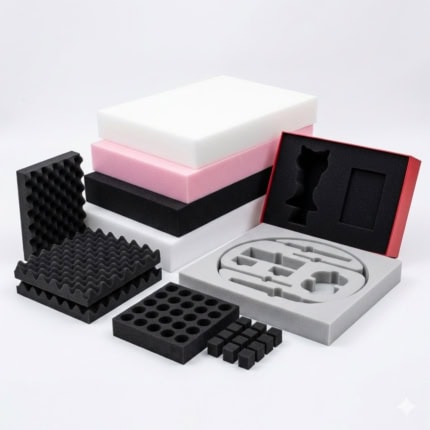
Custom PU foam may be appropriate when an instrument needs cushioning around its shape. Other foam materials may be preferable for different firmness or structural requirements, while inflatable packaging can provide supplementary protection in compatible shipping configurations.
Explore Mailong Packaging’s Inflatable Air Column Wrap and Bubble Cushioning Packaging for additional protective packaging options.
Custom PU Foam for Lab Instruments: Ordering Process
Mailong Packaging works with B2B buyers to discuss packaging requirements and identify the information needed to assess a custom foam insert.
Step 1: Provide Instrument Information
Share the instrument name, dimensions, weight, photographs, and available technical drawings. Identify delicate surfaces, exposed connectors, and any areas that should not be compressed.
Step 2: Confirm the Package Dimensions
Provide the internal dimensions of the box or case, including available length, width, and depth. If the package will also contain accessories, list their dimensions and quantities.
Step 3: Specify Material and Performance Requirements
Describe the expected handling conditions and any requirements related to cushioning, cleanliness, surface compatibility, or electrostatic discharge. These requirements should be confirmed before selecting the final material.
Step 4: Review the Proposed Layout
Check the cavity arrangement, instrument orientation, clearance, and accessibility of accessories. For new or sensitive applications, consider a sample or first-article review before approving bulk production.
Step 5: Confirm Quantity and Production Schedule
The stated minimum order quantity is 100 pieces, and the listed production time is 7–15 days. Actual lead time depends on design approval, material availability, order quantity, and production requirements.
The listed port is Shenzhen. Shipping arrangements, trade terms, and customs classification should be confirmed before dispatch. International transit time is additional to the production schedule.
Why Choose Mailong Packaging?
Established in 2009, Mailong Packaging is a manufacturer and exporter of protective packaging materials for international business customers. Our product range includes flexible PU foam, EPE and EVA foam, inflatable bubble and pillow film, air column rolls and bags, poly mailers, stretch wrap, bubble mailers, BOPP tape, and corrugated boxes.
Experience in Protective Packaging
Our range of packaging materials supports different product protection and shipping requirements. Buyers can discuss foam cushioning alongside outer packaging and other protective materials when developing a packaging setup for laboratory instruments.
Custom Packaging Discussions
Laboratory instruments vary considerably in shape, sensitivity, and handling requirements. Providing accurate measurements, drawings, and packaging details helps the team assess the required insert configuration and material specification.
International B2B Supply
Mailong Packaging has exported packaging materials to more than 30 countries. We serve business customers seeking packaging materials for manufacturing, distribution, and logistics operations.
Complementary Packaging Products
In addition to foam packaging, Mailong Packaging supplies Packing Tape BOPP Tape, Pallet Wrap Stretch Film, and Poly Mailer Shipping Bags for other packaging needs.
Company Information
-
Company Name: Mailong Packaging
-
Established: 2009
-
Address: Building A, Tiantou Hongjing Industrial Zone, Hengli Town, Dongguan City, Guangdong, China
-
Email: daveyang@mailongpak.com
-
Minimum Order Quantity: 100 pcs
-
Production Time: 7–15 days, subject to confirmation
-
Port: Shenzhen
Frequently Asked Questions About PU Foam for Lab Instruments
1. What is PU foam for laboratory instruments used for?
Flexible PU foam is used to cushion and organize laboratory instruments during storage and transportation. Custom inserts can provide designated spaces for the main device and compatible accessories, helping reduce unwanted movement inside a package.
2. Can laboratory instrument foam be customized?
Yes. The insert’s size, thickness, and cavity layout can be specified according to the instrument and package dimensions. Buyers should provide accurate measurements, drawings, or reference photographs to support design confirmation.
3. What is the MOQ for Mailong PU foam packaging?
The stated minimum order quantity is 100 pieces. Contact Mailong Packaging to confirm the applicable MOQ for your design and order requirements.
4. What is the production time?
The listed production time is 7–15 days. The actual schedule depends on the confirmed design, material availability, order quantity, and production requirements. Shipping time is additional.
5. Can PU foam protect calibration-sensitive instruments?
A suitable foam insert can help reduce unwanted movement and provide cushioning, but it cannot guarantee calibration retention. Calibration stability also depends on the instrument design, impact severity, vibration, environmental conditions, and handling. Follow the manufacturer’s transportation instructions and verify calibration when required.
6. Is flexible PU foam suitable for optical equipment?
It may be suitable when the material and insert geometry are selected for the equipment’s requirements. Sensitive optical surfaces and adjustment components may need additional clearance or specialized protection. Confirm surface compatibility and the intended contact points before production.
7. Is standard PU foam antistatic?
Not necessarily. Standard flexible PU foam should not automatically be considered antistatic or suitable for electrostatic-sensitive equipment. If ESD protection is required, specify the target performance and request confirmation of the material’s properties.
8. Can one insert hold an instrument and its accessories?
Yes, where the package dimensions and design permit. Separate cavities can be planned for suitable accessories such as probes, cables, adapters, or detachable components. Provide measurements for all items so the layout can be assessed.
9. Can PU foam be combined with other packaging materials?
Yes. Depending on the application, PU foam inserts can be used with protective cartons, cushioning wraps, and suitable sealing materials. Mailong Packaging also supplies EPE Foam Sheets, E Commerce Packaging Solution, and Eco Shipping Packaging for complementary packaging needs.
10. How can I request a quotation for custom laboratory instrument foam?
Email daveyang@mailongpak.com with the instrument dimensions, weight, packaging dimensions, quantity, and any special performance requirements. Technical drawings and product photographs are helpful for evaluating the proposed packaging design.
Request a Quote for PU Foam for Lab Instruments
Looking for a supplier of custom PU foam for laboratory instrument packaging? Mailong Packaging can help you discuss flexible PU foam, precision cushioning, customized dimensions, and packaging requirements for laboratory and measurement equipment.
To request a quotation, please provide:
-
Instrument dimensions and weight
-
Product photographs or technical drawings
-
Internal dimensions of the box or case
-
Required insert thickness and cavity layout
-
Special handling, calibration, cleanliness, or ESD requirements
-
Estimated quantity and destination market
Contact daveyang@mailongpak.com to discuss your project and confirm the appropriate material specifications.
Mailong Packaging — Protective Packaging Materials for Global B2B Customers Since 2009.